
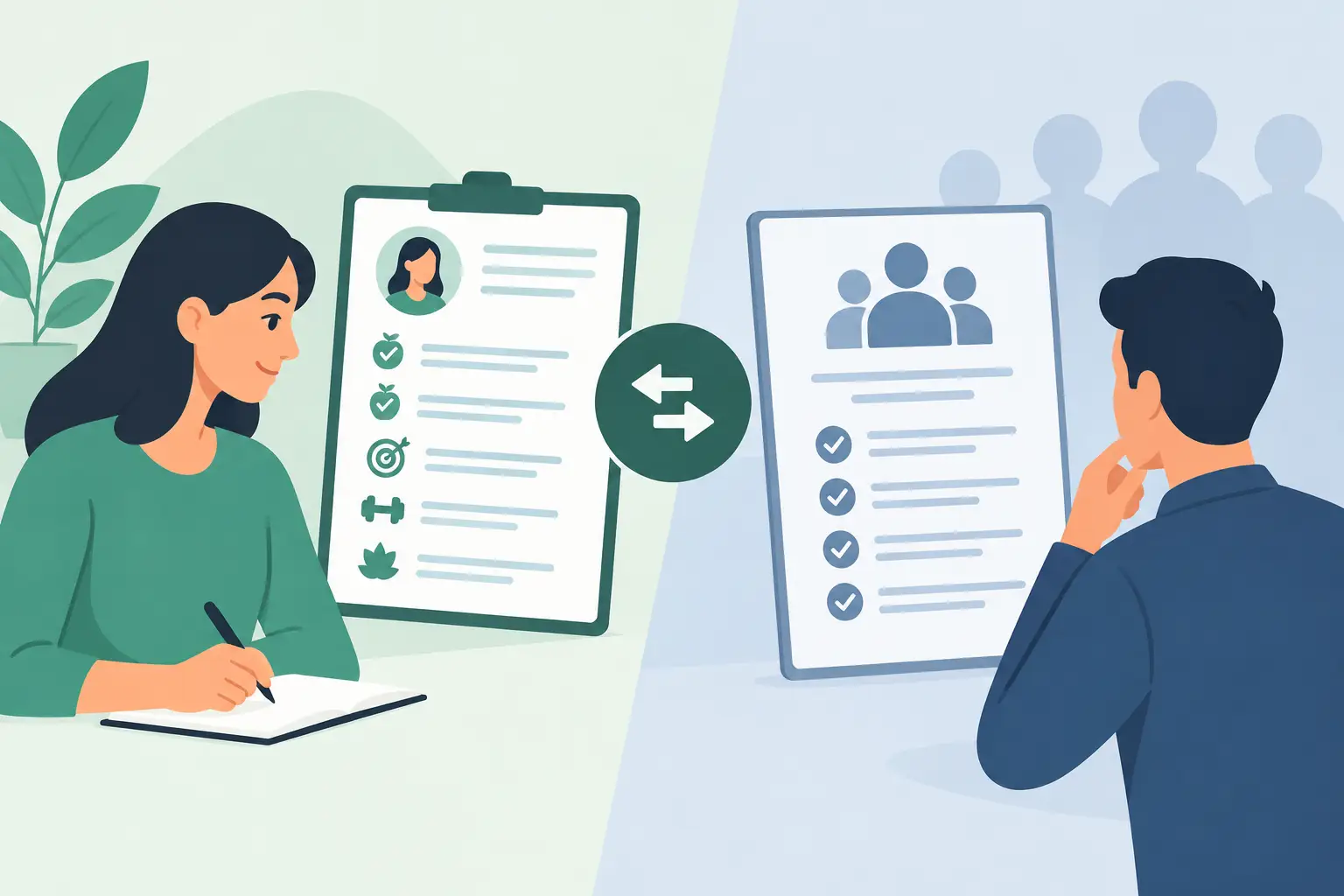
A personalised plan versus generic programme is not simply a choice between two workout formats. It is the difference between following a routine designed for an average person and training around your body, goals, schedule and starting point. If you are balancing work, family, travel or life in Barcelona, that difference can decide whether training becomes a lasting habit or another plan left unfinished after three weeks.
A generic programme can give you structure. For some people, especially those who already understand exercise technique, recover well and have a straightforward goal, it may be a useful place to start. But it cannot see when you are exhausted after a long week, when an old knee injury is affecting your squat, or when a race date suddenly changes. A coach can.
Personalised plan versus generic programme: the real difference
Most generic programmes are built around a fixed template: the same number of sessions, exercises, sets and progression for everyone who downloads or buys it. The programme may be well written, but it does not know whether you have trained consistently before, what equipment you have at home, how much sleep you get, or whether you genuinely enjoy running, lifting, boxing or outdoor conditioning.
A personalised plan begins with the questions that templates cannot ask. What do you want to achieve? How much time can you commit without making training another source of stress? What have you tried before? What hurts, what do you avoid, and what makes you feel capable?
From there, I can build training that has a clear purpose. A beginner wanting to feel stronger and lose body fat does not need the same programme as an experienced runner preparing for a half marathon. Someone training in a Barcelona flat with a pair of dumbbells needs a different approach from someone who has access to a park, a full gym or a home training space.
The exercises matter, but the reasoning behind them matters more. A good plan gives each session a job to do, whether that is building strength, improving movement quality, developing aerobic fitness or supporting recovery.
Your routine needs to fit real life
The biggest weakness of a generic programme is often not the training itself. It is the assumption that life will follow the programme perfectly.
A plan might prescribe five sessions a week, but perhaps you can reliably manage three. It might require a barbell, pull-up station and cable machine, while you have a resistance band and a clear corner of the living room. Or it may expect you to train hard every Monday, even though Monday is consistently your busiest day at work.
A personalised programme works with those realities rather than pretending they do not exist. If you can train twice during the week and once at the weekend, we build around that. If travelling disrupts your routine, you have practical hotel-room or bodyweight options. If you prefer early outdoor sessions before work, that becomes part of the structure.
This is not an excuse to make training easy. Progress requires effort and, at times, being pushed beyond your comfort zone. The point is to apply that effort intelligently. There is no value in an impressive plan that you cannot follow consistently.
Progression should match your level
Training needs to become more challenging over time, but not all progression means adding more weight every week. You might improve technique, complete more quality repetitions, shorten rest periods, run farther at the same effort or recover better between sessions.
For a complete beginner, learning how to hinge, squat, push, pull and brace properly may be the main priority. Loading complex movements too soon can create frustration or injury risk. For an experienced client, the focus may be on a structured strength block, race pacing, endurance conditioning or breaking through a long-standing plateau.
A generic programme usually progresses according to a calendar. Personal coaching progresses when you are ready. Some weeks you will be capable of more. During others, the smart move is to hold steady, adjust volume or focus on quality. That is not losing momentum. It is how you protect it.
Nutrition cannot be copied and pasted
Training is only one part of changing body composition, energy levels or sporting performance. Nutrition is where many people feel most confused because they have been given rigid rules that do not suit their lifestyle.
A meal plan copied from an app may look disciplined on paper, but it is unlikely to last if it ignores your work lunches, social life, food preferences, cooking confidence or training times. You do not need to eat perfectly to make progress. You need an approach you can repeat often enough for it to work.
With a personalised nutrition plan, the aim is to create useful structure: enough protein to support recovery, meals that keep you satisfied, fuel around demanding training and a sensible approach to portions. For a runner preparing for an event, fuelling requirements will look different from someone focused on fat loss. For a busy professional, simple meals and planning ahead may matter more than complicated recipes.
The goal is not to make food stressful. It is to give you clear decisions that support the result you want.
Accountability is the part an app cannot provide
Motivation is unreliable. Even highly committed people have weeks where work becomes intense, sleep drops or confidence takes a knock. A generic programme cannot notice that you have stopped logging sessions or ask why you missed two weeks of training.
Direct coaching creates accountability without judgement. We look at what happened, make an honest assessment and get moving again. Sometimes the answer is more discipline. Sometimes the plan needs to be simplified because it is asking too much at the wrong time. Knowing the difference is valuable.
For in-person personal training, I can also correct technique in the moment and adjust a session based on how you arrive that day. For remote coaching, regular feedback, check-ins and programme updates mean you are not left guessing whether your effort is taking you in the right direction.
That support is particularly useful if you have felt intimidated by conventional gyms or lost in fitness apps. You do not need to know every exercise before you begin. You need to be willing to learn, turn up and communicate honestly.
When a generic programme may be enough
There is a place for generic programmes. They are usually cheaper, easy to access and can provide a simple routine for people who do not need much guidance. If your goal is general movement, you have no injuries or specific performance target, and you are confident adapting exercises yourself, a template may serve you well for a period.
The trade-off is that you are responsible for all the decisions. You must judge technique, decide when to push or pull back, modify sessions around pain, organise your nutrition and keep yourself accountable. Some people enjoy that independence. Others spend months changing programmes without making meaningful progress.
Personalised coaching is most useful when the stakes are higher: you want visible body-composition changes, are returning after injury or a long break, have a demanding event ahead, struggle with consistency, or simply want to stop wasting time on routines that do not fit.
What a good personalised plan should include
A bespoke plan is not just your name typed at the top of a standard document. It should reflect your assessment, goals, training history, available time and equipment. It should tell you what to do, but also give you a way to understand why you are doing it.
You should expect clear sessions, realistic progression and adjustments as your fitness develops. You should also have space to discuss recovery, nutrition, confidence and the obstacles that tend to derail you. Whether we train at home, outdoors, in a small group or remotely, the programme should feel demanding but achievable.
At AB Fitness, that is the standard I work towards: practical training with a clear direction, not random hard sessions for the sake of being tired. My background in endurance sport, strength work, bodyweight conditioning and martial arts has taught me that different goals require different tools. The best programme is the one that helps you improve while keeping you able to come back and train again.
Choose the level of support that matches where you are now, not where you think you ought to be. Start with a plan you can carry through a normal week, then let consistent effort do its work.