
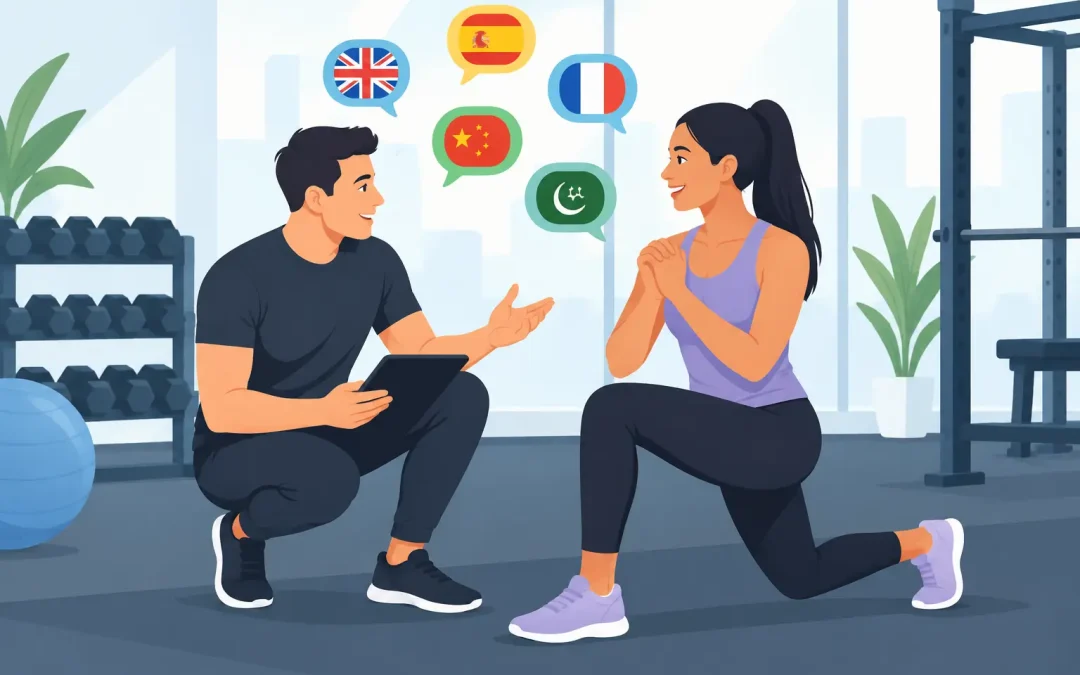
You are halfway through a challenging set, your breathing is up, and your trainer gives one key correction. If you have to translate it in your head before you can act on it, the moment has already passed. Multilingual personal training removes that unnecessary barrier, making coaching clearer, more comfortable and far more personal from your first session.
For many people in Barcelona, language is part of everyday life. You may work in English, speak Spanish with neighbours and use French with family or friends. Training should fit naturally into that reality. Whether your goal is to feel stronger, lose body fat, prepare for a race or simply build a routine you can maintain, being coached in a language you understand well can change the quality of the experience.
Why multilingual personal training matters
Fitness is not just about counting repetitions. Good coaching relies on clear communication: how an exercise should feel, when to push harder, when to stop, how to manage a niggle, and what needs to change between sessions. A programme only works when you understand the purpose behind it and feel confident enough to ask questions.
That is where multilingual coaching makes a practical difference. I coach in English, French and Spanish, so clients can train in the language that feels most natural to them. It is not about translating a worksheet word for word. It is about explaining the session in a way that makes sense to you, responding quickly when something feels wrong, and keeping the conversation straightforward.
This can be especially valuable for beginners. Walking into a gym environment can feel intimidating enough without worrying whether you have understood an instruction correctly. Training at home, outdoors or online already removes some of that pressure. Being able to communicate easily with your coach removes another layer.
Better coaching cues, better movement
Small details matter in training. A squat can be adjusted by changing your stance, bracing your torso, controlling the descent or shifting your weight through the feet. These are simple concepts, but they need to be understood in the moment, not read later in a generic app notification.
When we share a common language, feedback becomes more precise. I can explain why we are changing an exercise, check that you feel the intended muscles working and adapt the movement if your mobility, confidence or previous injuries require a different approach.
For experienced clients, this precision helps training move forwards. If you are preparing for a marathon, triathlon or demanding sporting event, you need more than a hard session. You need to understand pacing, recovery, fuelling and the reason a particular session sits where it does in your week. Clear communication prevents the common mistake of treating every workout as a test.
Nutrition advice that fits real life
Nutrition coaching can become confusing when it is buried under rules, jargon and unrealistic meal plans. It should be practical enough to use on a busy Tuesday, when work runs late and you still need to make a sensible choice.
A multilingual coach can discuss your usual meals, shopping habits, cultural preferences and schedule without making assumptions. That matters in a city with such an international population. The best nutrition structure is not a copied plan built around foods you never eat. It is an approach that gives you enough protein, energy and consistency while still fitting your life.
There will be times when precise calorie or macro targets are useful, particularly for body composition or race preparation. At other times, simpler habits are more effective: planning meals, improving portion awareness and building reliable protein sources into the day. The right approach depends on your goal, experience and relationship with food.
Who benefits from multilingual personal training?
Multilingual personal training is useful for anyone who values clear, direct support, but it is particularly suited to Barcelona’s international community. Expats who are still learning Spanish, professionals who work across several languages, and residents who simply express themselves better in English, French or Spanish can all benefit.
It also works well for couples and small groups. Friends do not always share the same first language or fitness level. A properly coached session can accommodate both. One person may be working on basic strength and confidence while another is building running fitness or progressing with heavier resistance work. The session can still feel shared, purposeful and enjoyable.
Remote coaching brings the same benefit to clients outside Barcelona. If you travel regularly or live elsewhere, training online gives you a structured plan, direct feedback and accountability without being tied to a particular gym. You still need to do the work, of course, but you are not left trying to decide what to do every time you exercise.
What a personal approach should look like
Language alone does not make training personalised. A coach may speak your language perfectly and still hand you a generic programme. Real personal training begins with understanding where you are now, where you want to get to and what your life realistically allows.
That means looking at your training history, work routine, sleep, stress, injuries, available equipment and time. Someone with two 45-minute slots each week needs a different strategy from someone preparing for an Ironman or a first half marathon. Neither goal is more valid, but the plan must reflect the person doing it.
At AB Fitness, I use that information to build training around the places and formats that suit you. Sessions can happen at home, outdoors in Barcelona or online. You may prefer bodyweight work, TRX, running sessions, boxing-inspired conditioning or strength training with the equipment you have available. Variety can keep training engaging, but it should never be random. Every session needs a reason.
Progress also needs to be measured in ways that matter to you. That might mean lifting with better technique, running further without stopping, having more energy at work, fitting into clothes differently or feeling confident enough to train independently between sessions. Scale weight can be useful data, but it is not the only sign that your effort is paying off.
Communication builds accountability
Most people do not struggle because they lack access to workouts. There are endless exercises and programmes online. The harder part is staying consistent when work gets busy, motivation dips or a missed session turns into three weeks away from training.
Accountability is more effective when it feels human. You should be able to tell your coach that you had a difficult week, slept badly or cannot make a planned session. Then the plan can be adjusted instead of abandoned. Equally, you need a coach who will challenge excuses when you are capable of more.
That balance is central to good coaching. I will not expect a beginner to train like an endurance athlete, and I will not pretend that a demanding goal can be achieved through occasional effort. Sustainable results come from a plan that is realistic, progressive and followed often enough to create change.
Choosing the right language for your sessions
Your strongest language is often the best starting point, particularly when learning new movements or discussing health history. But it does not have to be fixed forever. Some clients prefer the technical explanation in English but use Spanish or French conversationally during the session. Others switch naturally depending on the subject.
The important thing is that you feel heard and understood. Be clear about what you need from the start. Tell your coach if you prefer short, direct cues, detailed explanations, written follow-up notes or video feedback between sessions. The more open the communication, the more accurately the training can be tailored.
There is one trade-off worth recognising. Training in your preferred language does not automatically make exercise easy. You will still need to practise, build strength and show up when you would rather stay on the sofa. What it does give you is clarity: no uncertainty about the plan, no vague instructions and no need to pretend you understand.
The best training relationship should make you feel supported without being indulged. Choose a coach you can communicate with honestly, then give the process enough time to work. A clear conversation before your next session may be the first step towards the progress you have been trying to make alone.