
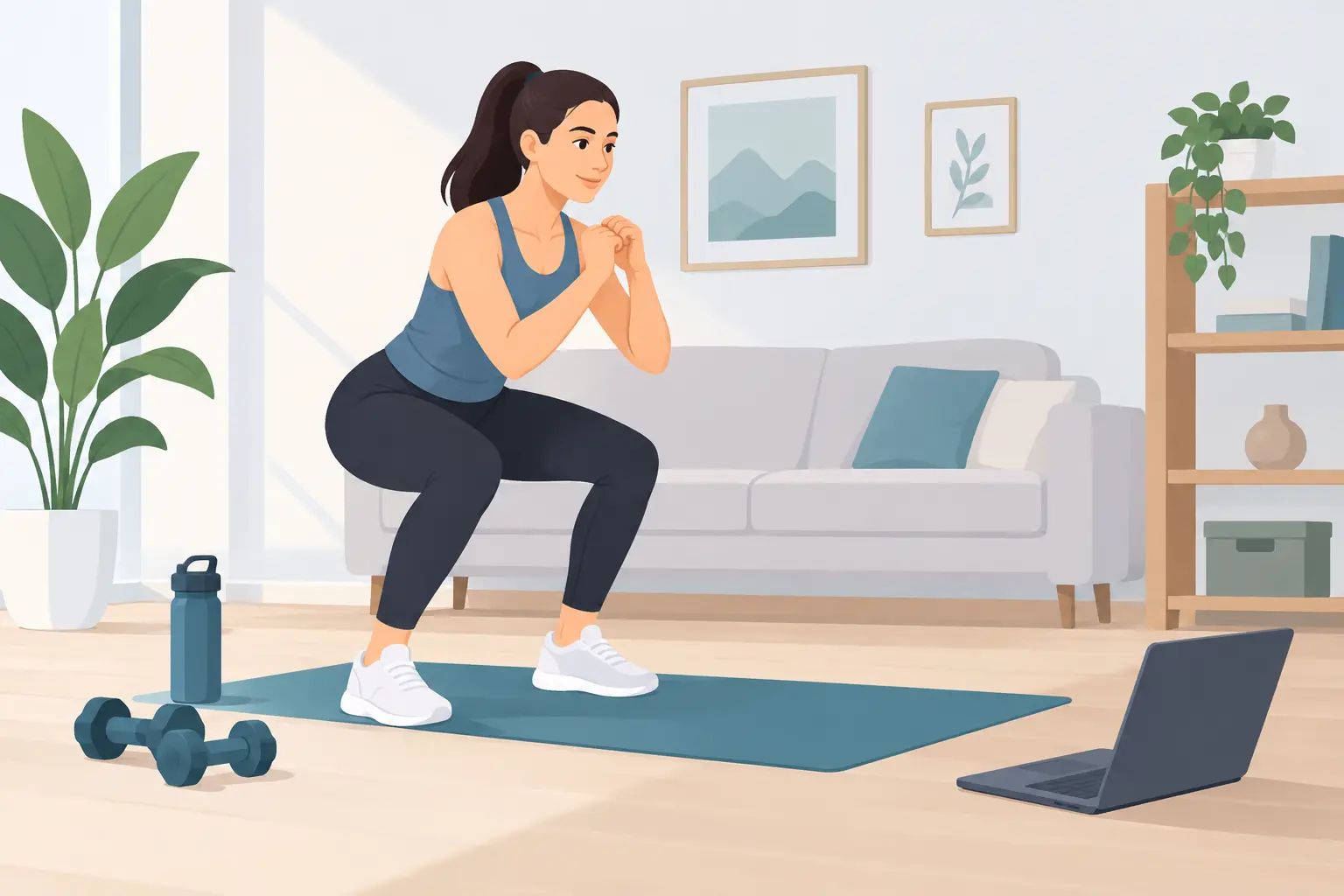
A spare corner of the living room, a chair and 30 minutes can be enough to start. Can beginners train at home and make real progress? Absolutely. You do not need a gym membership, complicated machines or a punishing daily routine. You do need a plan that fits your current fitness, your available space and the life you are actually living.
For busy professionals, parents, newcomers to Barcelona and anyone who feels uncomfortable in a gym, home training removes a major barrier: getting there. The key is not to replace a gym with random online workouts. It is to train with purpose, learn the basics well and build consistency before chasing intensity.
Can beginners train at home safely?
Yes, provided you begin at the right level. Most people do not get injured because they trained at home. They get injured because they try to copy a workout designed for somebody fitter, rush their technique or ignore pain because they feel they should be working harder.
Your first sessions should feel controlled rather than heroic. You should be able to breathe hard without feeling dizzy, maintain good positions and finish with the sense that you could have done a little more. That is not taking it easy. It is smart training, and it gives your body time to adapt.
At home, beginners can develop strength, mobility, cardiovascular fitness and confidence with bodyweight movements alone. Squats, presses, rows, hip hinges, lunges, carries and core work all have accessible variations. A resistance band, exercise mat and a pair of adjustable dumbbells can add variety later, but they are not a requirement for week one.
Your environment matters too. Clear enough floor space to move safely, wear supportive trainers if your surface is slippery, and use a stable chair rather than balancing on furniture that could move. If you have a health condition, a recent injury, persistent joint pain or you have been inactive for a long time, speak to a qualified professional before starting.
Start with movement, not punishment
A good beginner programme is built around movements you can repeat well. It should not leave you so sore that sitting down becomes a challenge for three days. A little muscle soreness is normal when you start, but it is not the measure of an effective session.
Begin with two or three full-body sessions per week on non-consecutive days. This gives you enough practice to improve while allowing time for recovery. On the days between, a brisk walk, gentle cycle or easy jog-walk can build your fitness without adding too much stress.
A simple session might include a squat to a chair, an incline press-up using a kitchen counter or solid table, a hip hinge or glute bridge, a row using a resistance band, and a plank variation. Start with one or two sets of eight to 12 controlled repetitions for each exercise. Rest when you need to, then focus on making every repetition look similar.
The best variation is the one you can control. A full press-up from the floor may be a future goal, but an incline press-up is often the stronger starting choice. Equally, holding onto a wall or chair during a split squat is not cheating. It allows you to train your legs well while learning balance and alignment.
Learn the signals that matter
Training effort can feel uncomfortable. Muscles may burn, your breathing may become heavier and your heart rate may rise. Those are normal responses. Sharp pain, tingling, joint pain that worsens with each repetition, dizziness or a feeling that something is not right are reasons to stop and reassess.
Technique does not need to be perfect before you begin. It improves through practice and feedback. Film a few repetitions from the side if you are training alone, or work with a coach who can make adjustments early. Small details such as keeping your ribs down during a press-up, controlling your knee during a lunge, or learning to hinge from the hips can make training more effective and more comfortable.
A realistic first four weeks at home
The first month is about creating evidence that you can keep promises to yourself. Three tough sessions followed by two weeks of doing nothing will not build momentum. Two manageable sessions every week will.
In week one, keep sessions short, around 20 to 30 minutes, and leave plenty in reserve. Learn the exercises and notice how your body responds. In week two, add a few repetitions or an extra set if you recovered well. In week three, improve the quality of each movement by slowing the lowering phase or using a slightly more challenging variation. In week four, review what felt good, what you skipped and what needs adjusting.
This gradual approach may sound less exciting than a 28-day transformation challenge, but it works. Strength and fitness are built through progressive overload: asking your body to do a little more over time. At home, that can mean adding repetitions, using a stronger resistance band, increasing range of motion, reducing support or improving control. You do not need to exhaust yourself to progress.
Keep a simple record after each session. Note the exercises, sets, repetitions and how difficult they felt. This gives you a clear answer when motivation drops. Rather than wondering whether you are improving, you can see that the chair squat which felt difficult in week one is now controlled, deeper and stronger.
Make home training fit your schedule
Convenience is the great advantage of training at home, but it can also make postponing easy. If the equipment is always there, it is tempting to tell yourself you will do it later. Later often becomes tomorrow.
Choose specific training slots and treat them like appointments. For some people, that means a 7am session before messages start arriving. For others, it is 30 minutes after work before they sit on the sofa. There is no universally perfect time. The best time is the one you can repeat most weeks.
Lower the friction as much as possible. Put your training clothes out the night before, keep your band or mat visible, and have your session written down before you begin. If you only have 15 minutes, train for 15 minutes. A short session keeps the habit alive and is far more useful than waiting for an imaginary free hour.
If you share a flat or have a busy household, quieter exercises can work well. Glute bridges, split squats, band rows, floor presses and controlled core training need very little space and do not involve jumping. If you prefer being outside, parks and seafront routes can become part of your routine, particularly for walking, running preparation or bodyweight circuits.
Nutrition and recovery still count
Home training is not separate from the rest of your life. You will get better results when your food, sleep and activity support the effort you are putting in.
You do not need a restrictive diet to begin. Focus first on regular meals, enough protein to support recovery, fruit and vegetables most days, and sensible portions that match your goal. If fat loss is your priority, consistency matters more than cutting out every food you enjoy. If your aim is strength, make sure you are not repeatedly under-eating and then wondering why sessions feel flat.
Sleep is often the overlooked part. Beginners commonly feel tired after starting a programme because their body is adapting to a new demand. Aim for a regular bedtime where possible, stay hydrated and give yourself at least one easier day each week. Recovery is where the adaptation happens.
When a coach makes the difference
Can beginners train at home independently? Yes. But knowing what to do is only part of the challenge. Many people stop because they are unsure whether they are doing enough, they lose momentum after a busy week, or they keep choosing workouts they enjoy rather than the work they need.
A personalised plan gives you a starting point that matches your ability, goals and equipment. Coaching adds another layer: someone to check technique, progress the programme at the right pace and hold you accountable when work, travel or motivation gets in the way. At AB Fitness, I work with clients in their homes, outdoors and online, adapting training around real schedules rather than expecting life to fit around a generic app.
Home training may not suit every goal forever. If you want to lift very heavy weights, you may eventually need more equipment or gym access. If you are preparing for a marathon, race-specific running will need to become a bigger part of the plan. But for building a strong base, improving body composition, feeling more energetic and becoming confident with exercise, home is an excellent place to start.
Start smaller than your ambition tells you to. Complete the first session, repeat it next week, then let consistency do the work. A training routine does not have to look impressive in your living room to change how you feel in every part of your life.