
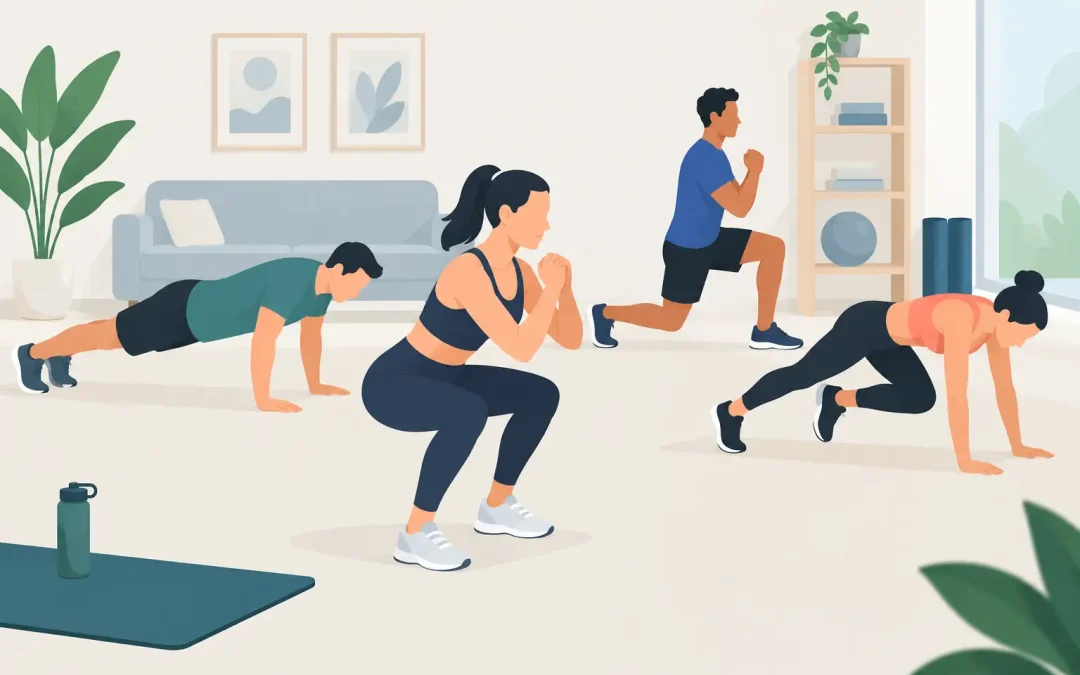
A good bodyweight session should not feel like a random circuit of squats and press-ups until you are exhausted. The best exercises for bodyweight strength build control, tension and confidence – whether you train in your Barcelona flat, a local park or while travelling for work. You do not need a gym full of machines to get stronger, but you do need a clear way to make each movement harder over time.
Bodyweight training works because your body is the load. The challenge is learning how to control that load through a full range of motion, with solid technique and enough effort to create change. For beginners, that may mean using a wall or bench for support. For experienced exercisers, it may mean slower reps, single-leg work, pauses and more demanding variations.
What makes bodyweight training effective?
Strength is not simply about doing high repetitions. If you can perform 30 quick, shallow squats, you have developed some muscular endurance, but you may not have challenged your strength much. To build strength without weights, make the exercise progressively more difficult while maintaining excellent form.
I look for four things in a good bodyweight programme: a squat pattern, a single-leg pattern, a pushing movement and a pulling movement. Core work and conditioning support those foundations, but they should not replace them. Many home workouts miss pulling entirely because there is no pull-up bar available. That is a limitation worth solving, especially if you spend long hours at a desk.
Your tempo matters too. Lowering for three seconds, pausing at the hardest point and standing or pressing with intent can turn a familiar exercise into a serious strength stimulus. Range of motion matters just as much. Work within a pain-free range, then gradually earn more depth or control.
The best exercises for bodyweight strength
Press-ups
The press-up is one of the most useful upper-body strength exercises available. It trains the chest, shoulders, triceps and trunk, provided your whole body moves as one unit. Think of it as a moving plank: squeeze your glutes, brace your abdominals and keep your hips from dropping towards the floor.
Start with hands on a wall, kitchen counter or sturdy bench if a floor press-up is not yet there. As you improve, lower the incline, then progress to floor press-ups. Stronger trainees can use a slow descent, a pause just above the floor, close-grip press-ups or feet-elevated press-ups. Do not rush to the hardest version. A clean set of eight controlled reps is more valuable than 15 half-reps with flared elbows and a sagging back.
Bodyweight squats and split squats
A bodyweight squat teaches you to sit between your hips while keeping your feet firmly planted. Stand with feet roughly shoulder-width apart, allow your knees to travel in line with your toes, and keep your torso as upright as your mobility allows. Use a chair target if you need to build confidence with depth.
Once regular squats become comfortable, split squats are usually the better strength progression. They load one leg at a time, challenge balance and expose left-to-right differences. Keep the front foot flat, lower the back knee towards the ground and let the front knee move naturally forwards. Bulgarian split squats, with the rear foot elevated on a sofa or bench, are highly effective but demanding. They are not compulsory for everyone, especially if knee comfort or balance is an issue.
Glute bridges and single-leg hip thrusts
Strong hips make walking, running, climbing stairs and lifting feel easier. Glute bridges are an accessible starting point: lie on your back, plant your feet close to your hips, then drive through your heels to lift your pelvis. At the top, squeeze your glutes without over-arching your lower back.
When two-legged bridges no longer challenge you, progress to a single-leg bridge or place your upper back on a stable sofa for a hip thrust. This is particularly helpful for runners and anyone who spends much of the day sitting. If you feel the movement only in your hamstrings, bring your feet slightly closer and focus on a controlled pelvic position.
Inverted rows or towel rows
Pulling is the movement most often neglected in bodyweight training. If you have access to a safe low bar, outdoor rail or sturdy table, inverted rows are excellent. Keep your body straight, pull your chest towards the bar or table edge, and avoid shrugging your shoulders up to your ears. The more horizontal your body, the harder the row becomes.
At home, a towel row can work only if the anchor point is unquestionably secure. Never use a door, rail or piece of furniture you have not checked carefully. Safety comes before creativity. If no safe row setup is available, resistance bands are a sensible, compact addition to a bodyweight programme, particularly for balanced upper-body training.
Pull-ups and chin-ups
If you have a reliable bar, pull-ups and chin-ups are among the best upper-body strength builders you can do. Chin-ups, with palms facing you, are often a more approachable first target than overhand pull-ups. Begin with dead hangs, shoulder-blade pulls and slow lowering repetitions if you cannot yet complete a full rep.
Do not train painful shoulders through stubbornness. Good pulling involves shoulder control, not just yanking with your arms. A band-assisted variation can be useful, but use one that still allows you to practise a smooth, controlled path.
Planks, side planks and hollow holds
Core training for strength is about resisting unwanted movement. A front plank teaches you to resist extension through the lower back, while a side plank challenges lateral stability. In both, a shorter hold with full tension is better than a long hold where your hips sink and breathing becomes panicked.
Hollow holds are a strong progression for people who want more control for running, martial arts or advanced calisthenics. Keep your lower back gently connected to the floor. Bend your knees or keep your arms by your sides if the full position is too difficult. The aim is quality tension, not forcing a shape you cannot hold.
Bear crawls
Bear crawls combine shoulder stability, trunk control and coordination. Start on hands and knees, lift your knees a few centimetres from the floor, then move slowly with opposite hand and foot. Keep your hips low and avoid rushing across the room.
They are excellent as a warm-up or finisher, but they can also build real strength when performed slowly and deliberately. They are a useful option for outdoor sessions where you want a full-body challenge without equipment.
How to progress without adding weights
Choose a variation that lets you complete roughly five to 12 good repetitions for most strength exercises. Stop one or two reps before technique breaks down. When you reach the top of that range across all your sets with control, make the movement more difficult.
You can progress by increasing range of motion, slowing the lowering phase, adding a pause, moving to a unilateral version, changing leverage or adding another set. For example, progress from incline press-ups to floor press-ups, then to paused floor press-ups. For legs, move from squats to split squats, then to rear-foot-elevated split squats.
More volume is not always the answer. If you already perform many reps, a tougher variation will often deliver a better strength result than simply adding more. That said, tendons and joints need time to adapt. Build gradually, particularly when returning to training after a break.
A simple three-day strength framework
Train three non-consecutive days each week if your schedule allows. On each day, include a lower-body movement, a push, a pull, a hip exercise and a core exercise. Complete two to four sets per movement, resting long enough to keep your form sharp – usually 60 to 120 seconds.
One session might use split squats, incline press-ups, inverted rows, glute bridges and side planks. A second could use squats with a slow descent, floor press-ups, assisted chin-up lowers, single-leg bridges and hollow holds. The exact exercises depend on your starting point, available space and any injury history. The structure stays useful because it covers the major patterns rather than chasing novelty.
If your goal is fat loss or general fitness, add walks, running, cycling or a short conditioning block around this strength work. If your priority is getting your first pull-up, stronger press-up or pain-free return to exercise, keep the programme focused and recover well. Training hard is useful. Training intelligently is what lets you repeat that effort week after week.
At AB Fitness, I build bodyweight plans around the equipment, space and time you actually have, then adjust them as you get stronger. The goal is not to make every session complicated. It is to give you a plan you can follow consistently, at home, outdoors or remotely.
Choose one variation you can perform well this week, record your reps and make a small improvement next week. Strength grows quietly at first, then one day the movement that used to feel impossible becomes your warm-up.