
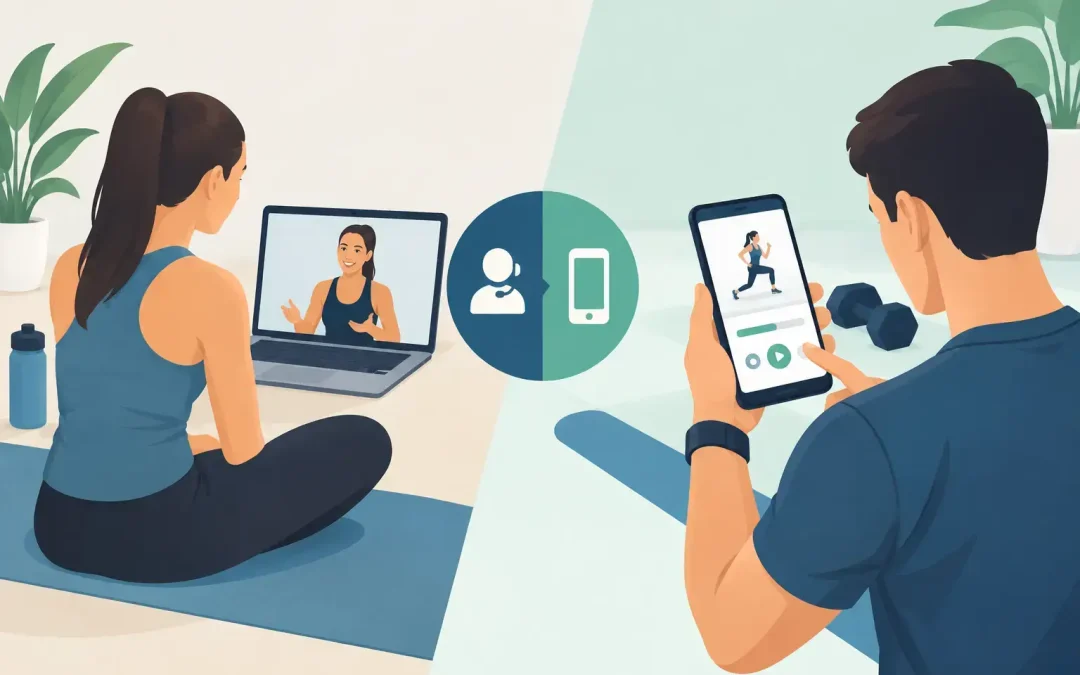
You finish a workout app session, tick the box and promise yourself you will train again tomorrow. Then work runs late, you travel, or the programme starts to feel too difficult – or too easy. That is where the real difference in remote coaching versus apps becomes clear. The question is not whether an app can give you a workout. Most can. The question is whether it can keep your training relevant when real life changes.
Apps can be useful tools. I use technology with clients every week to track sessions, review progress and keep plans accessible wherever they are. But a tool is not the same as a coach. If your goal is to build strength, lose body fat, prepare for a race or simply create a routine you can maintain, the level of support you need matters.
Remote coaching versus apps: the key difference
A fitness app is designed to serve thousands or millions of people at once. It may ask a few questions when you join, then direct you into a pre-built programme based on a broad goal such as fat loss, strength or running. That can be a helpful starting point, particularly if you are new to exercise and want ideas without much commitment.
Remote coaching starts from a different place. I look at your goal, training history, current fitness, injuries, schedule, equipment, food habits and the parts of training you tend to avoid. Your programme is then built around you, not around the average person who selected the same goal on a screen.
That distinction becomes more valuable after the first few enthusiastic weeks. Perhaps you only have 35 minutes between meetings. Perhaps your knee feels uncomfortable after a run. Perhaps you have access to a full gym one week and only a hotel room the next. An app may offer alternatives, but a coach can decide what should change, what should stay and when it is better to push on or pull back.
Personalisation is more than choosing a difficulty level
Many apps now describe their plans as personalised. Usually, that means the app adjusts exercise selection or workout length based on a short questionnaire and your previous ratings. It is better than blindly following random workouts online, but it is still limited by the information it can interpret.
A bespoke remote plan accounts for the details that influence results. If you are a busy professional in Barcelona, early-morning sessions may be the only realistic option. If you are an experienced runner targeting a half marathon, your strength work needs to support your running rather than leave your legs exhausted for every key session. If you are returning to exercise after years away, the first goal may be consistency and confidence, not punishing workouts.
I also programme for the equipment you actually have. A pair of dumbbells, resistance bands, a park bench and your bodyweight can be enough to make real progress when the plan is structured properly. You do not need a fancy gym or a flat full of equipment. You need exercises that match your ability, clear progression and a reason for every session.
The plan should move as you improve
Training is not a fixed six-week challenge. Your capacity changes as you become stronger, fitter and more confident. The programme should change too.
With coaching, I can review completed sessions, ask how movements felt and adjust the following week. If squats are becoming comfortable, we may increase load, repetitions or control. If work stress has wrecked your sleep, we may protect the habit with a shorter session instead of pretending recovery does not matter. This is not an excuse to avoid effort. It is a way to direct effort where it will have the best return.
Accountability changes what happens on difficult weeks
Motivation is useful, but it is unreliable. Nobody feels equally driven after a poor night’s sleep, a long day or a weekend away. An app can send reminders and offer badges. For some people, that is enough. For many, notifications quickly become another thing to dismiss.
Remote coaching adds a human commitment. You know someone is looking at your progress, expecting honest feedback and ready to help you solve the obstacle rather than abandon the plan. That can be especially effective for people who know what to do but struggle to do it consistently.
Accountability should never mean guilt. Missing a session does not ruin your progress. What matters is identifying why it happened and making the next step practical. If evening workouts keep disappearing, we might move sessions to the morning. If meal choices unravel during busy workdays, we can create a simpler structure around breakfast, lunch and protein intake. The aim is to build a routine that survives normal life, not a perfect plan that only works during a quiet month.
Nutrition needs context, not generic targets
Apps are often good at recording calories, steps and weight. Data can be useful, but it does not automatically tell you what to do next. A daily calorie target may look precise while ignoring hunger, training volume, social plans, food preferences and whether you can realistically follow it.
In remote coaching, nutrition guidance should support your training and your lifestyle. For one person, that may mean a straightforward meal schedule to stop skipping lunch and overeating later. For another, it may mean learning how to fuel long runs while gradually improving body composition. There is no value in handing you a restrictive plan that makes you miserable and lasts ten days.
You also need perspective when the scales fluctuate. Water retention, travel, hard training and a salty meal can all affect your weight from one day to the next. A coach helps you look at the wider trend and make measured adjustments rather than reacting emotionally to every number.
When an app may be the right choice
Apps are not the enemy, and coaching is not necessary for every person at every stage. An app may suit you if your budget is tight, you are happy creating your own structure, you have a solid understanding of technique and you enjoy training independently. It can also be a sensible way to test whether a particular style of exercise interests you.
The limitation appears when you need more than content. If you are stuck at the same weight or strength level, unsure how to train around an old injury, preparing for a race, or repeatedly starting and stopping, generic sessions may not solve the underlying problem. More workout options are not always the answer. A clearer plan often is.
There is also a middle ground. You may enjoy using an app to log runs or monitor activity while following a coach-led plan. The technology can make training easier to follow; it just should not replace professional judgement.
Who benefits most from remote coaching?
Remote coaching works particularly well for people who want expert direction but cannot commit to fixed gym times. You might travel regularly, work unpredictable hours, live outside Barcelona, or prefer training at home or outdoors. As long as you can communicate honestly and commit to the process, coaching can fit around your life.
It is not only for advanced athletes. Beginners often benefit greatly because they learn good movement patterns and avoid the cycle of trying random workouts until something hurts. Experienced exercisers benefit because they have a structured progression and a coach who can challenge them beyond the comfortable routines they have repeated for years.
For endurance goals, the value is even clearer. Preparing for a marathon, triathlon or race requires more than adding kilometres each week. Running volume, strength work, recovery, fuelling and pacing all need to work together. My own background in marathons, Ironman triathlons and multi-sport training informs that process, but your plan will still be built around your experience and target.
What to expect from good remote coaching
A good coach should make training clearer, not more complicated. You should know what you are doing, why you are doing it and what to focus on during each session. You should also be able to ask questions when something does not feel right or when life gets in the way.
At AB Fitness, remote coaching is built around direct contact, tailored training and realistic nutrition support. You train where it suits you, while your plan remains connected to a real person who understands the goal behind it. That personal relationship is what turns a programme from a collection of workouts into a process.
The best choice is the one you will follow consistently. If an app gets you moving and you enjoy the independence, use it well. But if you want a plan that adapts, honest accountability and support from someone invested in your progress, remote coaching gives you far more than another workout to tick off. Start with the routine you can sustain, then give it enough structure to take you somewhere meaningful.