
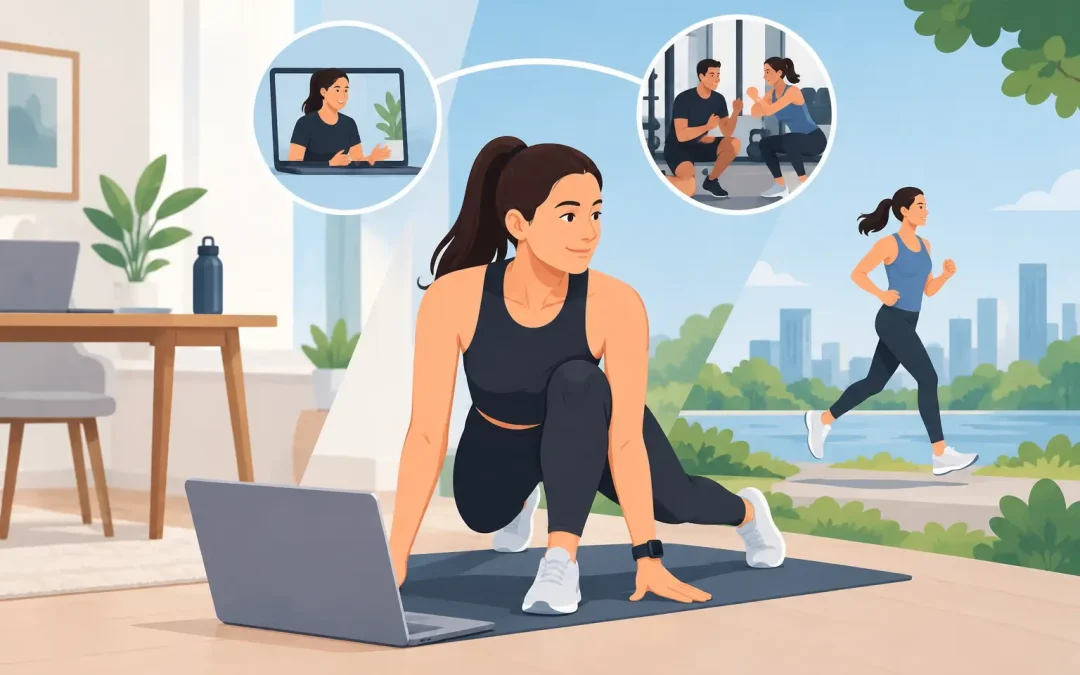
A good plan should not fall apart because you have a late meeting, travel for work or cannot make the park on your usual morning. Hybrid coaching gives you a real coach, real structure and a practical way to keep moving when life changes. It combines face-to-face personal training with tailored online programming, so your progress does not depend on being in one place at one time.
For busy people in Barcelona, that flexibility can be the difference between another stop-start fitness kick and a routine that finally sticks. You might train with me outdoors or at home once or twice a week, then follow a clear programme independently between sessions. If you are travelling, working from another city or simply need to train at a different time, your plan comes with you.
What hybrid coaching actually looks like
Hybrid coaching is not a generic workout app with a monthly subscription. It is personal training supported by remote coaching. We begin with your goals, current fitness, training history, schedule, equipment and any injuries or concerns that need to be considered. From there, I build a programme around the result you want and the life you actually have.
Your in-person sessions are where we can focus on technique, effort and progression. I can correct your squat, refine your running form, push the final set when you would usually stop early, and adjust the session immediately if something does not feel right. This is particularly valuable for beginners, people returning after time away from exercise, and anyone who has spent years following random workouts without knowing whether they are doing them well.
Your online training covers the days between sessions. You receive a structured plan with exercises, sets, reps, rest periods and guidance that matches your ability. Depending on your goals, this might include strength work at home, bodyweight conditioning in a hotel room, running sessions along the seafront, mobility work or nutrition habits to support body composition and energy.
We stay in contact, review how the training is going and make changes when needed. The goal is not to give you more tasks to manage. It is to remove the guesswork so you know exactly what to do when it is time to train.
Why hybrid coaching works for busy schedules
Most people do not struggle because they lack motivation every day. They struggle because their plan only works under perfect conditions. A fixed gym class, a rigid timetable or a programme that needs lots of equipment can be difficult to maintain once work and family commitments pile up.
A hybrid approach creates consistency without pretending every week looks the same. If you have time for a full coached session, we use it well. If you only have 30 minutes at home on Thursday, you still have an effective session ready to go. If you are away for a few days, training does not have to disappear until Monday.
That consistency matters more than chasing the hardest workout. Strength, fat loss, improved fitness and better running all come from progressive work repeated over time. A plan that is slightly less dramatic but completed for months will beat an ambitious plan abandoned after two weeks.
There is also a useful balance of support and independence. You are not left alone to make every decision, but you are also not reliant on your trainer being physically beside you for every exercise. Over time, you learn how to train with more confidence, understand your own effort levels and build habits that hold up outside the session.
Face-to-face coaching keeps standards high
There is no substitute for having a coach watch how you move. Small adjustments can make a major difference to how an exercise feels and how effectively you perform it. This is especially true when learning compound movements, working towards heavier loads or returning to training after an injury.
In person, I can also judge when to challenge you and when to hold back. Some clients need more confidence before increasing intensity. Others have plenty of ability but need someone to raise the standard and keep them accountable. Both situations need an individual response, not a one-size-fits-all programme.
Online support protects your momentum
Remote coaching is where the plan becomes part of your week rather than an isolated appointment. You can train at a time that suits you, refer back to your workout details and stay focused on the next useful step.
For international professionals and frequent travellers, this is a major advantage. You do not need to restart your fitness routine every time your location changes. Your programme can adapt to a hotel gym, a small flat, a nearby park or no equipment at all. The training stimulus may change, but the direction stays clear.
Who benefits most from hybrid coaching?
Hybrid coaching can work for complete beginners, experienced gym-goers and endurance athletes, but the format should look different for each person.
If you are new to exercise, the in-person sessions help you establish safe technique and a realistic routine. Your online work can be simple and manageable, perhaps two short strength sessions and regular walking to begin with. There is no need to train six days a week to get results. The right starting point is the one you can repeat.
If you already train but feel stuck, hybrid coaching adds structure. You may know plenty of exercises but lack a clear progression plan, suitable recovery or honest accountability. We can use face-to-face sessions to test your limits and improve weak areas, while the remote programme makes sure every other session supports the same goal.
For runners preparing for a 10K, half marathon, marathon or triathlon, the blend is particularly useful. Your running plan needs to fit around strength work, work commitments, recovery and race dates. One coached session can focus on strength, conditioning or running mechanics, while your weekly running sessions are programmed remotely with a clear purpose. As someone with experience in marathons, Ironman triathlons and multi-sport training, I know that more training is not always better. The right session on the right day matters.
The trade-off: flexibility still needs commitment
Hybrid coaching is flexible, but it is not passive. A personalised plan only works if you follow it, communicate honestly and make room for training in your week. The coach provides the route and keeps you accountable. You still need to take the steps.
This format may not suit someone who wants every workout led in person or who finds it impossible to train independently. In that case, more frequent face-to-face sessions may be the better choice. Equally, if you are highly experienced, disciplined and confident with technique, a mostly online approach could be enough with occasional check-ins.
The best balance depends on your goal, experience, budget and schedule. A client aiming to build confidence after years away from fitness may benefit from weekly in-person coaching. Someone preparing for a race with a busy travel diary may prefer a fortnightly session alongside detailed remote programming. There is no prize for choosing the most complicated format, only for choosing one you can sustain.
How to make your programme work
Start by being clear about what you want, but stay open about the route. “I want to lose weight” is a valid goal, yet it becomes more useful when connected to practical behaviours: three strength sessions per week, a daily step target, better meal structure and consistent sleep where possible. If your priority is strength, we track lifts and repetitions. If it is a race, we build training around the event date and your current running level.
It also helps to protect a few regular training windows in your calendar, even when the exact session can move. Treat them like appointments with yourself. Then use the remote plan for the moments when your schedule shifts rather than deciding the day is lost.
At AB Fitness, I use hybrid coaching to give clients the personal attention of one-to-one training without making their progress dependent on a single location. Whether we train in your home, outdoors in Barcelona or remotely from wherever work takes you, the programme stays built around you.
Fitness should support a fuller life, not demand a perfectly organised one. With the right coaching, a changing schedule becomes something to plan around, not an excuse to put your goals on hold.