
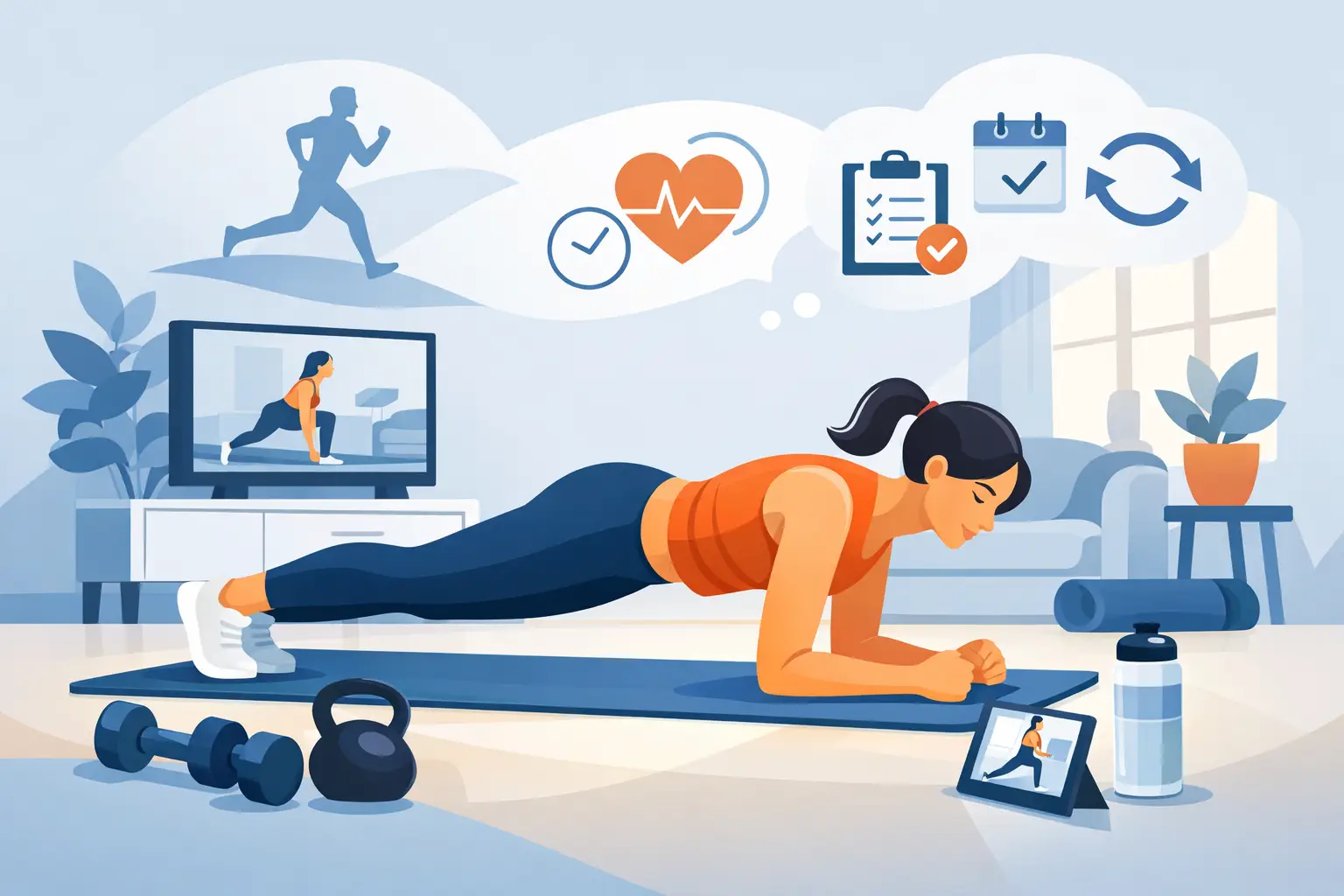
A spare corner of your living room, 30 minutes before work, and a plan you can repeat are enough to begin. If you are wondering how to start home workouts, do not wait until you have a perfect routine, a fully equipped garage gym or more motivation. Start with a session that fits your current fitness, your space and the life you actually lead.
Home training can be exceptionally effective, but it asks for a little more intention than turning up at a gym. There is no commute, no queue for equipment and no one automatically expecting you at a certain time. That convenience is the advantage, but it can also make consistency harder. A clear structure turns your home into a place where training happens rather than another place where plans get postponed.
Start Home Workouts With a Clear Goal
The best first question is not, “What is the hardest workout I can do?” It is, “What do I want this routine to improve?” Your goal might be losing body fat, feeling stronger, reducing stiffness after long days at a desk, preparing for a race or simply getting back into regular exercise.
Choose one main priority for the next six to eight weeks. You can still gain several benefits at once, but a main focus guides your sessions. Someone building general strength needs a different starting point from a runner who wants stronger legs and better resilience, or a beginner whose first goal is to move without feeling overwhelmed.
Make the goal practical. Rather than saying you want to get fit, set a target such as completing three 30-minute sessions each week, doing ten controlled press-ups from an incline, or walking and running 5 km comfortably. These are targets you can measure and adjust.
Assess Your Starting Point Honestly
You do not need a fitness test that leaves you exhausted. I would rather see a new client move well at an appropriate level than force a maximum effort on day one. Take note of how you feel during a brisk 10-minute walk, how comfortably you can sit down and stand up from a chair, and whether you can hold a stable plank position for a short period without holding your breath.
Pay attention to previous injuries, recurring pain and medical conditions. Sharp pain, chest pain, dizziness or unusual shortness of breath are signs to stop and seek professional medical advice. If your knees, back, shoulders or hips are sensitive, exercises can usually be adapted, but ignoring discomfort is not disciplined training.
This honest starting point is useful because progress is personal. A controlled bodyweight squat to a chair can be the right exercise for one person, while another may need single-leg work, added resistance or faster running intervals. Neither is better. They are simply different stages of training.
Create a Space You Will Actually Use
You can train effectively in a small Barcelona flat. Clear enough room to lie down with your arms out, check that the floor is not slippery and move fragile furniture out of the way. If you live above neighbours, low-impact movements such as squats, glute bridges, split squats, press-ups and resistance-band exercises may be more practical than repeated jumping.
At the beginning, your bodyweight is more than enough. A sturdy chair, a mat or towel, and a backpack that can be loaded with books give you plenty of options. Resistance bands and a pair of adjustable dumbbells are worthwhile later because they make progression easier without taking over your home.
Do not buy lots of equipment before you have built the habit. Equipment does not create commitment. A programme you understand, scheduled sessions and gradual progression do.
Build Your First Week Around the Basics
For most beginners, two or three full-body strength sessions per week is a strong starting point. Leave at least one rest day between strength sessions, particularly when you are new to exercise or returning after a long break. Add walks, easy cycling, jogging or another form of cardio on the days between if it suits your goal and recovery.
Each strength session should cover the fundamental movement patterns: a squat or lunge, a hip hinge, a push, a pull and core control. A simple session could include chair squats, glute bridges, incline press-ups against a kitchen counter, backpack rows and a dead bug exercise. Perform two or three sets of each, stopping with a couple of good repetitions still available rather than training to failure.
Start with controlled reps. Move through a comfortable range, keep your breathing steady and focus on technique before speed. Ten tidy squats are more useful than 30 rushed ones with your knees collapsing inwards and your back rounding.
A warm-up does not need to be complicated. Spend five minutes marching on the spot, circling your shoulders, mobilising your hips and practising the movements you are about to use at an easy level. At the end, slow your breathing and take a moment to note what felt good and what needs adjusting next time.
Make Progress Without Chasing Exhaustion
A workout should challenge you, but being unable to walk properly for four days is not a sign of success. It is usually a sign that you progressed too quickly. The goal is to do enough work to stimulate improvement, then recover well enough to train again.
Use one change at a time. You might add one or two repetitions, a little weight to your backpack, an extra set, a slower lowering phase or a more demanding variation. Once chair squats feel easy, for example, lower to the chair more slowly, hold a loaded backpack, or progress towards a free bodyweight squat.
Keep a simple training note on your phone. Record the exercise, sets, repetitions and how hard it felt out of ten. This gives you evidence of progress on the weeks when the mirror or scales do not tell the whole story. Better control, more energy, improved posture and a stronger routine all count.
Plan for Motivation to Dip
Motivation is welcome, but it is not reliable enough to be your entire plan. Put your sessions in your diary as appointments, ideally at a time with the fewest competing demands. Lay out your clothes beforehand and decide the session before you start. Small barriers are often what stop a session happening.
Have a minimum version ready for busy days. If you cannot complete 30 minutes, do ten. A short session of squats, press-ups, rows and a brisk walk protects the habit. It also prevents the familiar pattern of missing one workout, then feeling as though the whole week has gone wrong.
Training with a partner can help, especially for couples or friends sharing a home. Keep the programme appropriate for each person rather than making it a competition. One person may use the floor for press-ups while the other uses an incline, and both can work at the right level.
Support Your Training With Everyday Nutrition
You do not need a restrictive diet to begin exercising. Aim for regular meals that include a source of protein, fruit or vegetables, and carbohydrates that support your activity level. Protein helps recovery and keeps meals satisfying, while carbohydrates are useful fuel for strength work, running and longer sessions.
Hydration, sleep and stress management affect training more than people expect. If you have slept badly or had a demanding week at work, reduce the session slightly rather than abandoning it. Consistency over months beats the occasional all-out workout followed by burnout.
If body composition is your goal, avoid trying to change everything overnight. Training, nutrition and daily movement work together. A bespoke plan can make the process more straightforward because it accounts for your schedule, preferences, experience and the equipment you have available.
When Personal Coaching Makes the Difference
Home workouts are flexible, but flexibility can become guesswork if you are unsure what to do next. Coaching is useful when you want form checked, progression planned, accountability built in or a programme that fits a specific target such as a race, post-injury return or fat-loss goal.
At AB Fitness, I coach clients at home, outdoors in Barcelona and remotely, adapting sessions to the person in front of me rather than applying a generic app workout. The aim is not to make every session brutal. It is to make each session purposeful, progressive and realistic enough to sustain.
Your first home workout does not need to look impressive. It needs to happen, feel manageable and give you a reason to return tomorrow or later this week. Clear a little space, choose a level you can control and let the routine grow from there.