
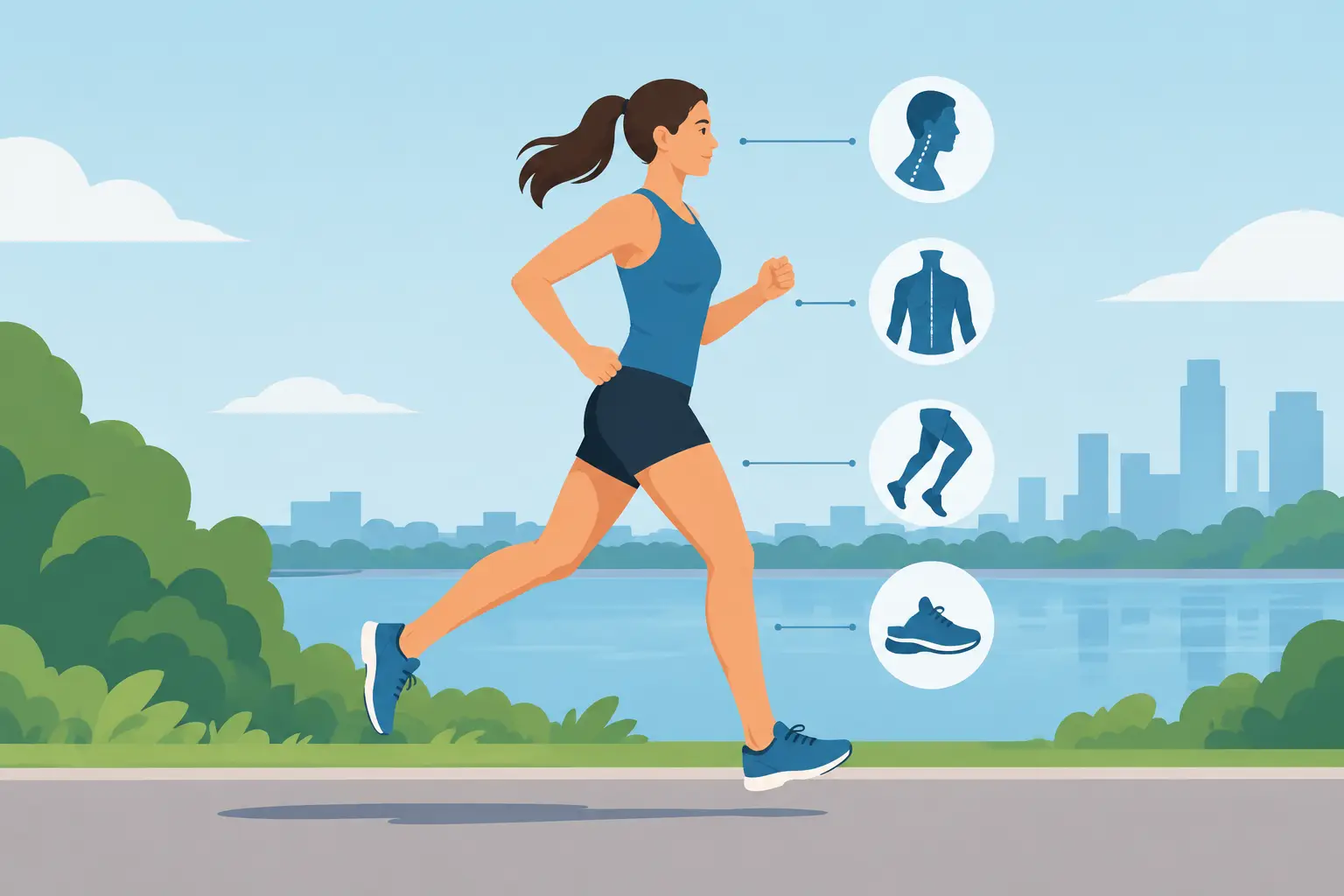
A good run should not feel like a fight with the pavement. If you finish every easy run with tight shoulders, heavy feet or a sore lower back, learning how to improve running form can make your training feel smoother and more controlled. The goal is not to copy an elite runner’s stride. It is to find an efficient movement pattern that suits your body, current fitness and running goals.
I have seen runners make huge progress simply by stopping the habits that waste energy: reaching too far with the foot, clenching the hands, staring at the ground or trying to run every kilometre too hard. Form work is not about looking perfect. It is about helping you run comfortably enough to train consistently.
Start with posture, not your feet
Most runners try to fix their stride by looking down at their feet. In practice, the movement usually starts higher up. Your head, ribcage and pelvis set the position from which your legs can work.
Run tall, with your gaze directed several metres ahead rather than at the pavement directly in front of you. Keep your chin neutral and let your shoulders sit down and back without forcing them into a military posture. Think of length through the crown of your head, not stiffness through your chest.
Your body should have a small forward lean from the ankles. This is subtle. Do not bend at the waist, stick your bottom out or hunch your shoulders forwards. A gentle whole-body lean helps you move forwards while keeping your hips underneath you. If you feel pressure building in your lower back, reset by breathing out fully, relaxing your ribs and bringing your pelvis back to neutral.
For runners in Barcelona, this matters even more on warmer days. Heat can make you tense your shoulders and collapse through the torso as fatigue builds. A quick posture check at the start of each kilometre can prevent that gradual deterioration.
How to improve running form through your arms
Your arms do more than keep you balanced. They set rhythm and help keep rotation under control, particularly when you are tired or running uphill.
Aim for elbows bent at roughly 80 to 100 degrees, with your hands relaxed. Imagine you are holding a crisp packet without wanting to crush it. Your hands should travel forwards and backwards, not sweep across your body. Excessive arm swing across the chest often twists the torso and pulls the legs out of a clean line.
Do not obsess over holding your arms at one exact angle. Taller runners, sprinters and trail runners may all look slightly different. The useful question is whether your shoulders stay relaxed and whether both arms swing evenly. If one arm is crossing the body much more than the other, it can be a sign of tension, fatigue or a strength imbalance worth addressing.
A simple drill is to run for 30 seconds while paying attention only to your elbows moving backwards. This usually tidies the arm action without creating a long list of cues to remember.
Let your feet land underneath you
Overstriding is one of the most common issues I see in recreational runners. It happens when the foot reaches too far ahead of the hips, often with a straight knee and a pronounced heel strike. The problem is not heel striking itself. Plenty of strong, injury-free runners land on their heels. The issue is braking hard with each step.
Instead, aim to place your foot closer to underneath your body. Your knee should be soft as you make contact, allowing the ankle, knee and hip to share the load. You may land on the heel, midfoot or a mixture of both depending on your pace, shoes and anatomy. Trying to force a forefoot strike can overload the calves and Achilles tendon, especially if you change too quickly.
Think “quiet feet” rather than “land on your toes”. On a relaxed easy run, listen to your footfall. If every step sounds like a stamp, shorten the stride slightly and increase the rhythm. This cue is usually more effective than trying to analyse every part of your foot contact.
Use cadence as a guide, not a rule
Cadence means steps per minute. You may have heard that everyone should run at 180 steps per minute. That figure is not a universal target. Cadence naturally changes with height, pace, terrain and experience.
What matters is whether your current rhythm is helping you avoid a long, braking stride. If you regularly feel as though you are leaping from one foot to the other, or your shins and knees ache after easy runs, a modest increase in cadence can help. Start by increasing your normal easy-run rhythm by around 3 to 5 per cent for short sections. Do not jump from 155 steps per minute to 180 overnight.
Use music, a watch alert or a metronome only if it helps you stay relaxed. If it makes you tense or turns an easy session into a test, leave it alone. Good form should support your running, not give you another number to worry about.
Build form at an easy pace first
You cannot learn efficient movement while gasping through every run. Easy running is where you can practise posture, rhythm and relaxation without fatigue taking over. You should be able to speak in short sentences for most of the session.
Once or twice a week, add four to six relaxed strides after an easy run. These are not sprints. Run for 15 to 20 seconds, gradually building to a fast but controlled pace, then walk or jog until fully recovered. Strides teach you to move with quicker, lighter mechanics without the pressure of a hard interval session.
Short hill efforts are another excellent tool. A gentle incline naturally encourages a shorter stride, stronger knee drive and a slight forward lean. Try six to eight repetitions of 10 seconds up a moderate hill, with a full walk-back recovery. Keep the effort sharp but never desperate. Stop if your technique starts to fall apart.
Strength and mobility make better form easier
Running form is partly coordination, but it also depends on having enough strength to hold your position when tired. If your hips drop, knees collapse inwards or trunk starts rotating late in a run, no verbal cue will solve the issue on its own.
Prioritise simple strength work two times per week. Split squats, step-ups, deadlifts, calf raises, glute bridges and controlled single-leg work build the capacity runners need. Core training should focus on resisting unwanted movement: planks, side planks, carries and dead bugs are often more useful than endless crunches.
Mobility can help, but it is not a magic fix. You do not need extreme flexibility to run well. Focus on maintaining comfortable movement through the ankles, hips and upper back, especially if you spend long days at a desk. A five-minute warm-up with ankle rocks, leg swings, walking lunges and easy skips is more practical than a long stretching routine you will not keep up.
Change one thing at a time
The fastest route to a niggle is trying to change everything in one run. New shoes, higher cadence, forefoot landing, hill sprints and extra mileage are too many new stresses at once. Your calves, feet and tendons need time to adapt, even when a change feels positive.
Choose one cue for a two-week block. It might be relaxed shoulders, quieter feet or a slightly quicker rhythm. Practise it on easy runs, then forget about it for the rest of the session. If discomfort increases or does not settle, return to your normal style and get individual advice before pushing on.
A video filmed from the side and behind can be useful, but do not judge yourself harshly from one clip. Form changes with pace, fatigue, hills and surface. The real measure is whether you can run more comfortably, recover well and build training consistently.
At AB Fitness, I use running form as part of a wider plan that includes sensible mileage, strength work and race-specific sessions. There is no value in a beautiful stride if the training load is wrong.
Your next run does not need a complete rebuild. Pick one simple cue, keep the effort easy and give your body time to learn. Consistent, comfortable running is where better form earns its place.