
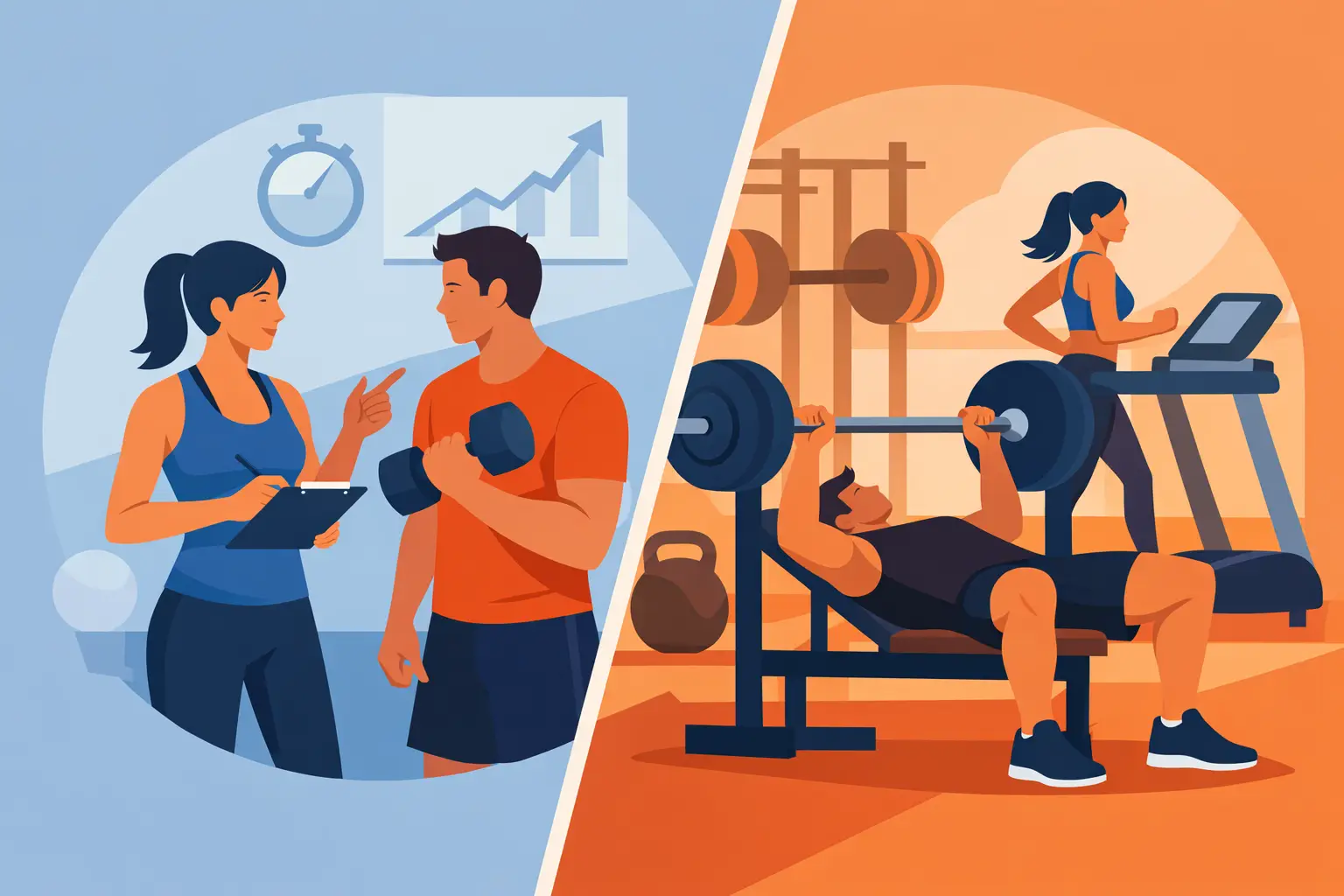
A gym membership can feel like a fresh start on the day you buy it. Three weeks later, it is easy for work, travel, rain or a lack of direction to get in the way. That is the real question behind trainer versus gym: not which option looks best on paper, but which one you will use consistently enough to make progress.
For some people, a gym is exactly the right environment. For others, the fixed location, busy floor and do-it-yourself approach become the reason training stops. A personal trainer gives you a plan, a time in the diary and someone who notices when you are ready to do more. The better choice depends on your goals, experience, budget and the practical reality of your week.
Trainer versus gym: the difference is support
A gym gives you access to equipment and space. That can be excellent value if you already know how to train, enjoy working independently and can reliably make time to go. You choose the exercises, manage your progression and decide whether your technique is good enough. Nobody is waiting for you if you miss a session.
A trainer provides more than a workout. I assess where you are starting from, build sessions around your goal, adapt training as you improve and make sure each exercise has a purpose. You are not left wondering whether you should be lifting heavier, running further or changing your food habits.
That difference matters most when motivation is inconsistent. Motivation is useful, but it is not a dependable training system. A scheduled session at home, outdoors or online removes several decisions before you have even started. You do not need to pack a bag, travel across Barcelona or work out what to do when you arrive.
When a gym membership is the sensible choice
A gym may suit you well if you enjoy the atmosphere, have one close to home or work, and feel confident using the equipment. It can also be a strong option for experienced lifters who need barbells, cable machines or heavier loads that are not practical at home.
The gym works particularly well when training is already a habit. If you can follow a programme, train with good form and adjust your workload intelligently, access to a wide range of equipment gives you plenty of options. Some people simply like the separation: they leave the office, enter the gym and focus for an hour.
Cost is another factor. A basic monthly membership is usually cheaper than one-to-one coaching. If finances are tight and you are prepared to learn, a gym can be a useful starting point. Just be honest about the full value of a membership you rarely use. The cheapest option is not always the best value if it produces no consistent action.
A gym also has limitations. Peak-time crowds can make a 45-minute session take much longer. You may wait for equipment, feel self-conscious as a beginner or repeat the same comfortable routine because it is familiar. None of these problems makes gyms bad. They simply show why access alone does not guarantee results.
What a trainer changes
Personal training gives structure to effort. Instead of collecting random workouts from social media or copying the person next to you, you follow a programme built for your body, schedule and target.
For a beginner, that often means learning the foundations properly: squatting, hinging, pushing, pulling, carrying, bracing and moving with control. Good coaching makes training feel less intimidating without making it too easy. You develop confidence because you understand what you are doing and why.
For someone with experience, coaching can provide the push that self-directed training no longer delivers. It may mean correcting a plateau, building strength without aggravating an old injury, preparing for a marathon or making body-composition progress without extreme dieting. Training should be challenging, but the challenge needs to be appropriate.
Accountability is often the biggest advantage. When someone knows your goal, your previous sessions and the barriers that tend to derail you, it becomes harder to disappear for three weeks and call it a busy period. I will adjust the plan when life gets demanding, but I will also expect you to keep moving forward.
Nutrition support adds another practical layer. You do not need a restrictive meal plan that ignores your work lunches, family dinners or social life. You need a clear structure that supports your training and can be repeated. Small changes applied consistently beat a perfect plan abandoned on Monday evening.
Convenience can be a performance advantage
People often treat convenience as a luxury. For busy professionals, parents and frequent travellers, it is more like a training tool. If the session happens in your flat, local park or through online coaching, the time and friction involved are dramatically lower.
Home and outdoor training do not require a room full of machines. With bodyweight work, resistance bands, dumbbells, kettlebells, TRX and intelligent programming, you can build strength, fitness and confidence in a small space. As your needs change, the programme changes too.
This is especially useful in Barcelona, where outdoor space can become part of the training environment rather than an obstacle. A park session may be more enjoyable than another hour indoors, while still being structured and progressive. For clients travelling regularly, remote coaching keeps the routine going wherever they are.
Which option is better for your goal?
If your goal is general health and you genuinely enjoy independent exercise, a gym may be enough. Use a straightforward programme, track your sessions and set a realistic weekly target. Consistency matters more than finding the perfect workout.
If your goal is weight loss or body recomposition, the answer depends on how much clarity you need. Training helps build muscle, improve fitness and create momentum, but food choices and daily habits play a major role. A trainer can give you both a focused exercise plan and practical nutritional accountability, rather than leaving you to piece advice together.
If you want to get stronger, technique and progressive overload matter. A gym offers useful equipment, but a trainer helps you use it well. You can also train effectively at home or outdoors when the programme matches the equipment available. The key is not whether an exercise looks advanced. It is whether you can perform it well and progress it over time.
For endurance goals such as a 10K, half marathon, marathon or triathlon, personalised coaching becomes particularly valuable. Running more is not always the answer. You need the right balance of easy running, quality sessions, strength work, recovery and fuelling. I have completed Ironman triathlons and marathons, so I understand that race preparation has to fit around ordinary life as well as the event itself.
A middle ground often works best
This does not have to be a strict choice between trainer and gym. Many clients get the best results from combining both. You might train with a coach once or twice a week for technique, progression and accountability, then complete independent gym sessions from a tailored plan.
That approach gives you expert direction without requiring every workout to be supervised. It works well if you like the gym but want confidence that your time there is productive. It can also suit couples or friendship groups: shared small-group sessions make coaching more affordable while keeping the plan personal.
Online coaching is another middle ground. You receive a bespoke programme, direct feedback and regular adjustments, while training in your own gym, at home or while travelling. It is not the same as having a trainer beside you for every repetition, but it is far more individual than a generic fitness app.
Ask yourself the questions that matter
Before paying for either option, think beyond the monthly price. Where are you most likely to train after a long day? Do you know what to do when you get there? Have you been consistent on your own before? Are you training for a specific result, or do you simply need to feel fitter and more confident?
Also consider what has stopped you in the past. If it was boredom, a gym class or outdoor sessions may help. If it was uncertainty, poor technique or a lack of follow-through, coaching is likely to give you more value. If it was time, bringing training closer to home may be the change that finally makes the routine stick.
The right choice is the one that turns good intentions into repeatable sessions. Start with the support you need now, not the version of yourself you hope will suddenly enjoy doing everything alone.