
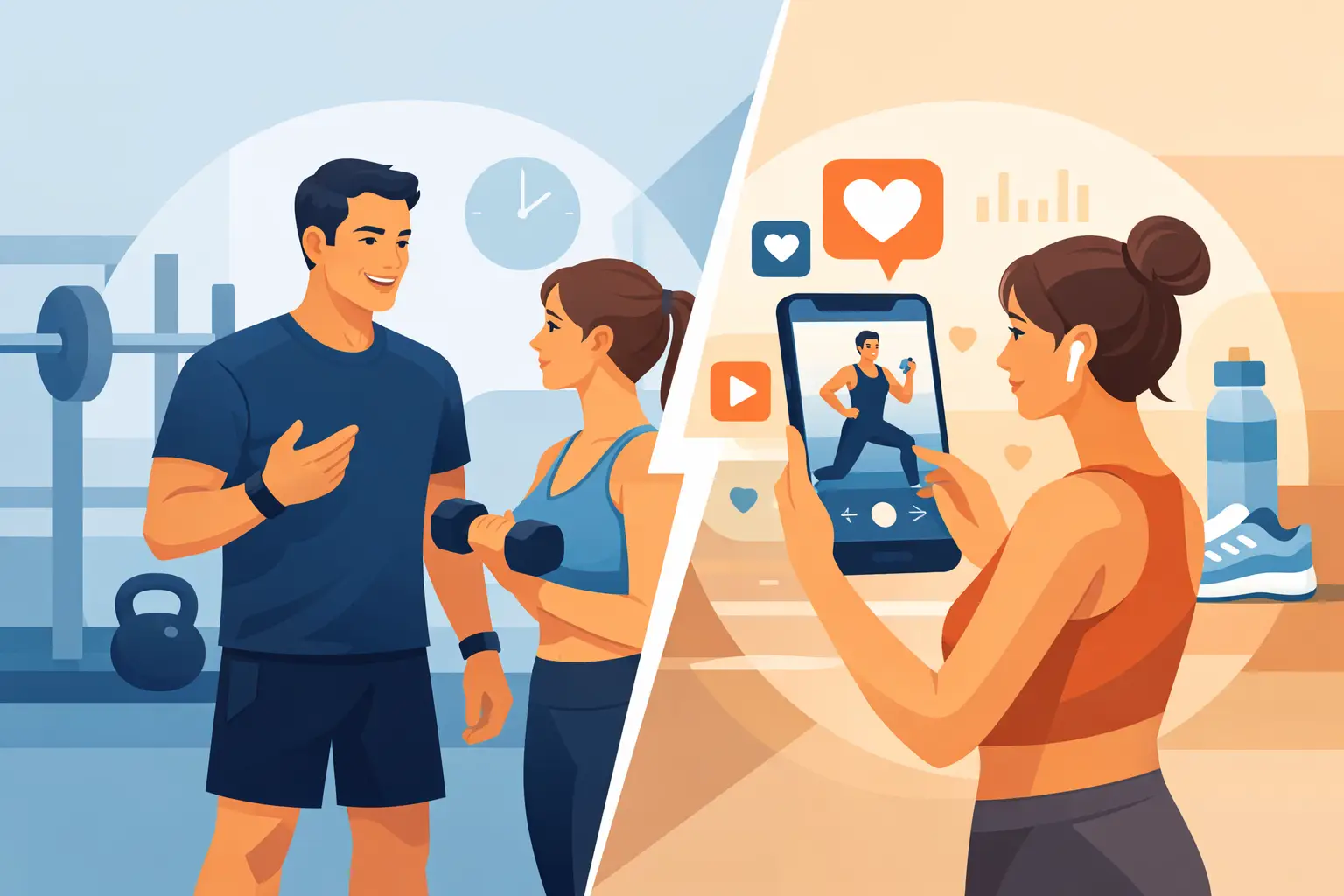
A fitness app can give you a workout before your first coffee. A personal trainer can see that your squat is shifting to one side, ask why you slept badly, and change the session before a small issue becomes a reason to stop training. That is the real question behind personal trainer versus fitness app: not which option is universally best, but which one will help you train consistently and make progress in your actual life.
For busy people in Barcelona, that life might include long working days, travel, family commitments, a small flat, or a schedule that changes every week. You may want to get stronger, lose body fat, prepare for a race or simply feel more confident in your body. Both apps and coaching can play a useful part. They do not, however, offer the same experience.
Personal trainer versus fitness app: the key difference
A fitness app is designed to serve many people at once. It may offer a large exercise library, follow-along classes, calorie tracking, reminders and pre-built plans for strength, running, yoga or fat loss. For someone who already understands good technique, enjoys training independently and needs a simple structure, that can be enough to get moving.
A personal trainer works in the opposite direction. I start with you: your goal, training history, current fitness, injuries, available equipment, work pattern and what you are realistically prepared to do each week. The programme is then built around those details, rather than asking you to fit your life around a generic plan.
This matters because two people can choose the same goal and need completely different routes to reach it. A beginner who wants to lose weight may need confidence with basic movement, simple nutrition habits and two manageable sessions a week. An experienced runner preparing for a marathon may need strength work, pacing guidance, recovery planning and a programme that accounts for existing mileage. An app can suggest a template. A coach can make decisions.
When a fitness app is a good choice
Apps have genuine strengths. They are usually cheaper than one-to-one coaching, available at any hour and easy to use when you are travelling or have 20 minutes free at home. If your main barrier is a lack of ideas, an app can stop you wasting time deciding what to do.
They can also work well for people who like autonomy. Perhaps you have trained for years, know how to use a gym safely and only want a clear session to follow. Or perhaps you need a short mobility routine after sitting at a desk all day. In these cases, a subscription may be a sensible, low-pressure option.
The limitation appears when the plan no longer matches the person. Many apps respond to your choices with an algorithm, but they cannot properly assess how you move, how hard you are actually working or whether your knee discomfort needs a technique adjustment, a reduced load or a referral to another professional. They cannot read the room when motivation has dropped for three weeks.
There is also a common trap: downloading an app feels like taking action, while completing the training is another matter. A library containing thousands of workouts can become another decision to make after a demanding day. Choice is useful until it creates hesitation.
What a personal trainer brings that an app cannot
The biggest value of personal training is not simply having someone count repetitions. It is having a knowledgeable person responsible for the process with you.
Coaching that adapts in real time
Your body does not perform exactly the same way every week. Stress, poor sleep, work travel and a hard weekend can affect energy, recovery and concentration. During an in-person session, I can adjust the pace, exercise selection or intensity immediately while keeping the session productive.
That adjustment is equally valuable remotely. A well-designed online plan should not be a document sent once and forgotten. It should include direct feedback, progress checks and changes based on what you report and achieve. The programme develops as you do.
Technique, confidence and progression
Good form is not about making every movement look identical. It is about helping you move safely and effectively for your body, then building strength and control over time. This is especially useful for beginners, people returning after a long break and anyone who has felt intimidated in a conventional gym.
Training at home or outdoors can be surprisingly effective when the sessions are planned properly. You do not need a room full of machines to improve fitness, strength and body composition. Bodyweight work, TRX, resistance bands, dumbbells, running sessions and intelligent conditioning can all produce results. What matters is progression: knowing when to add load, volume, complexity or recovery.
Accountability with a human being
Most people do not struggle because they have never seen a workout online. They struggle because consistency is difficult when no one notices whether the session happened.
A booked session creates commitment. So does knowing that someone will ask how the week went, look at the data and help you deal with setbacks without turning them into failure. Accountability is not being shouted at. It is having support, standards and a plan that stays alive when motivation is low.
Nutrition support that fits normal life
Training plans often fail because food is treated as an afterthought. You do not need an extreme diet, complicated rules or a week of perfect eating followed by giving up. You need structure that works with your schedule, preferences and goal.
Personal nutrition coaching can help you organise meals, understand portion sizes, fuel sessions and make practical choices when you are eating out or travelling. An app can track calories, which some people find helpful. But numbers alone do not explain why you overeat in the evening, skip lunch between meetings or lack energy for training. A coach can help turn information into habits.
The cost question: price versus value
There is no avoiding the difference in price. A fitness app costs far less than regular personal training. If money is tight, an app may be the best place to begin, particularly if it helps you establish a routine rather than doing nothing.
But compare the full value, not just the monthly subscription. If you repeatedly stop and restart generic plans, train inconsistently or waste months following workouts that do not suit your goal, the cheaper option may not be the more effective one. Personal training is an investment in tailored programming, feedback, scheduling and accountability.
There are middle-ground options too. Small-group training can make coaching more affordable while adding the energy of training with a partner or friends. Remote coaching offers personalised programming and direct contact without needing to meet in person every week. This can work well for international clients, frequent travellers and self-motivated people who still want expert oversight.
Which option suits your goal?
If your target is general activity and you are happy to train alone, a fitness app may be all you need. Choose one simple plan, follow it for several weeks and resist the urge to switch every time a new workout appears.
If you have a specific outcome – such as building strength, changing body composition, recovering confidence after injury, preparing for a 10K, marathon or triathlon – coaching is usually the stronger choice. Specific goals need specific decisions. Endurance preparation, for example, is more than adding more kilometres. It requires sensible progression, strength work, recovery and a realistic understanding of your available time.
Personal training is also worth considering when you know what to do but still do not do it. That is not laziness. Often, the plan is too vague, too demanding or disconnected from the way you live. A good coach makes the next step clear and keeps it achievable without lowering the standard.
A practical way to decide
Ask yourself three honest questions. Do I need someone to teach me how to train well? Do I need accountability to train consistently? Do I need a plan that changes around my work, travel, energy levels or a specific goal?
If the answer is no to all three, an app may be a very good fit. If one or more answers are yes, personalised coaching could save you time and frustration. You do not have to choose between expensive gym membership culture and training alone with your phone. At AB Fitness, sessions can take place at home, outdoors or remotely, with a programme designed around where you are now and where you want to get to.
The best training method is the one you can follow long enough to become stronger, fitter and more confident. Start with the level of support you genuinely need, then give the process enough time to work.