
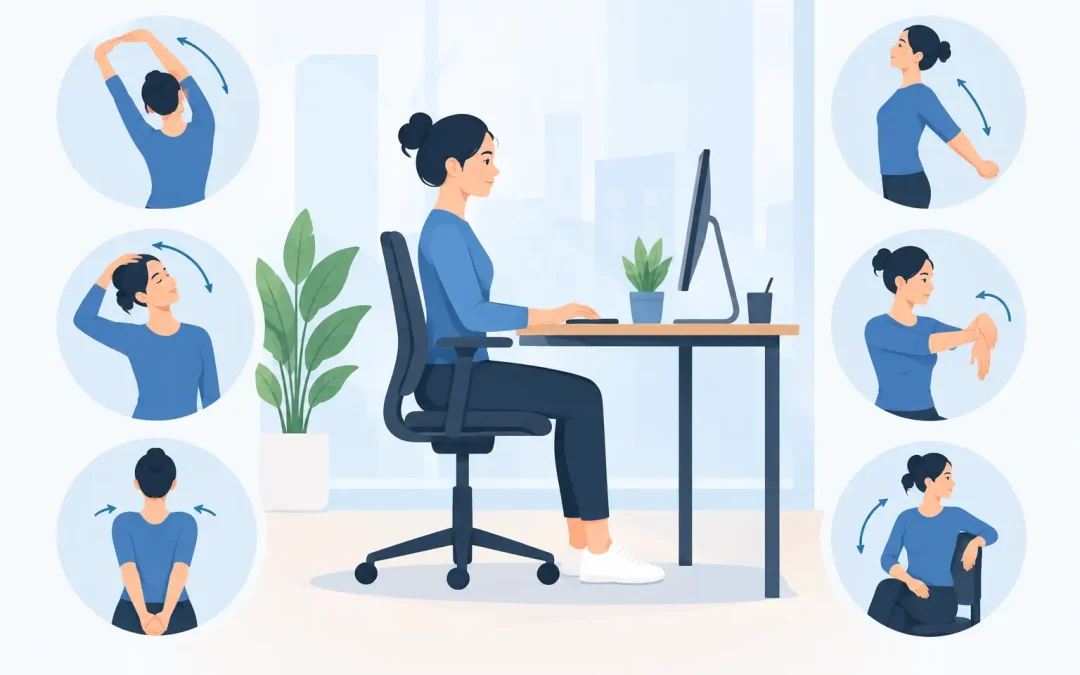
A stiff neck at 4pm, shoulders creeping towards your ears during a video call, or a lower back that complains when you stand up are not signs that you need to sit perfectly still. Usually, they are signs that you have been in one position for too long. The best exercises for desk posture build strength where you need support, restore movement where you feel restricted, and give you a practical reason to leave the chair regularly.
For busy professionals, posture work should not become another complicated task on the to-do list. A short, consistent routine is far more useful than one long session you never repeat. I focus on movements that improve your ability to move well, train well and feel more comfortable through a working day.
Why desk posture is not just about sitting up straight
There is no single perfect posture that you must hold for eight hours. Even an upright position becomes uncomfortable when it is held for too long. The bigger issue is usually low movement variety: hours with the hips bent, chest and upper back supported by a chair, and hands fixed in front of the body.
That pattern can leave your hip flexors feeling tight, your upper back less mobile and your neck doing more work than it should. It can also affect training. If you are trying to improve your running, strength training or body composition, restricted movement and persistent aches make it harder to stay consistent.
Exercise will not compensate for a poorly arranged workstation or every source of pain. Adjust your screen so you are not continually looking down, keep the keyboard close enough that you are not reaching, and take regular movement breaks. Then use the exercises below to develop the capacity to hold and change positions comfortably.
The best exercises for desk posture
You do not need a full gym for this routine. A resistance band, a wall and a little floor space are enough. Complete it two to four times per week, or split a few exercises across your day. Keep every repetition controlled. The aim is not to force a stretch or chase fatigue, but to give your body better options than the desk position.
1. Chin tucks for neck control
Chin tucks are small, but they are useful for people who spend hours leaning towards a laptop. Stand tall against a wall, or sit with your back supported. Gently draw your chin straight backwards, as though making a double chin, without tipping your head up or down. Hold for three seconds, relax and repeat for 8 to 12 repetitions.
You should feel the front and deep muscles of the neck working lightly, not a pinch at the base of your skull. This is not about aggressively pulling your head backwards. Keep it subtle and controlled.
2. Wall slides for shoulders and upper back
Stand with your back against a wall, feet a small step forwards and ribs gently down. Place your arms against the wall in a bent, goalpost shape if your mobility allows. Slowly slide your arms upwards, then return without shrugging your shoulders.
Aim for 2 sets of 8 to 10 repetitions. If your lower back arches away from the wall or your shoulders pinch, reduce the range. Wall slides train upward shoulder movement while asking the upper back and trunk to stay organised, which is valuable when your day is dominated by rounded, forward-reaching positions.
3. Thoracic rotations to regain upper-back movement
Your thoracic spine is the middle section of your back. It is designed to rotate, yet desk work often keeps it relatively still. Start on all fours with one hand behind your head. Rotate that elbow down towards the opposite wrist, then slowly open it towards the ceiling. Let your eyes follow the elbow, while keeping your hips as steady as possible.
Complete 6 to 8 slow repetitions on each side. Breathe out as you rotate open. Do not force range, especially if you feel discomfort in the lower back. A smoother upper back can reduce the urge to get movement by constantly twisting the neck instead.
4. Doorway chest stretch with control
A doorway stretch can feel excellent after a long day, but it works best when it is gentle. Place one forearm on the frame with your elbow slightly below shoulder height. Step forwards until you feel a mild stretch across the chest and front of the shoulder. Hold for 20 to 30 seconds each side, breathing normally.
Avoid turning this into a battle. If you stretch too intensely, you may irritate the front of the shoulder. Follow the stretch with a pulling or rowing movement so your body learns to control the improved range rather than simply hanging in it.
5. Resistance-band rows for stronger posture muscles
Rows are one of the most useful strength exercises for desk workers. Anchor a resistance band securely around a solid point at chest height. Take the band in both hands, stand tall and pull your elbows back towards your sides. Pause briefly when your shoulder blades move towards each other, then return slowly.
Perform 2 to 3 sets of 10 to 15 repetitions. Keep your neck relaxed and avoid leaning backwards to make the pull easier. Rows strengthen the upper back, rear shoulders and arms, but their real value is learning to control your shoulder blades through a full range.
If you already train in a gym, seated cable rows, dumbbell rows and suspension-trainer rows can all do the job. The best choice depends on your equipment, experience and whether you can perform it without compensating through the lower back.
6. Glute bridges to counter hours of sitting
Sitting does not switch your glutes off, but it does mean they spend much of the day in a lengthened, inactive position. Glute bridges are a simple way to train hip extension and give your lower body useful strength.
Lie on your back with knees bent and feet flat on the floor. Exhale, gently brace your midsection and press through your feet to lift your hips. Stop when your body forms a comfortable line from shoulders to knees, squeeze the glutes briefly, then lower with control. Complete 2 to 3 sets of 10 to 15 repetitions.
Do not chase maximum height. If you feel only your lower back, reduce the range and think about bringing your ribs slightly down before lifting. As you get stronger, progress to single-leg bridges, hip thrusts or loaded deadlift variations within a properly structured programme.
7. Hip-flexor stretch with a glute squeeze
A half-kneeling hip-flexor stretch is more effective when you create stability first. Kneel on one knee with the other foot in front. Tuck your pelvis slightly by squeezing the glute of the kneeling leg, then move your whole body forwards just a few centimetres. You should feel the stretch at the front of the hip, not compression in the lower back.
Hold for 20 to 30 seconds per side and repeat once or twice. Keep your torso tall. For many people, especially runners and cyclists, this is a useful addition, but it should sit alongside hip strength rather than replace it.
8. Dead bugs for trunk control
A strong core is not about holding your breath or doing endless crunches. It is about controlling your trunk as your arms and legs move. Dead bugs are ideal for practising this without loading the spine heavily.
Lie on your back with arms pointing towards the ceiling and hips and knees bent to 90 degrees. Press your lower back gently into the floor, then slowly lower the opposite arm and leg as far as you can without losing that contact. Return and alternate sides for 6 to 10 repetitions each.
Move slowly enough that you can notice when your back wants to arch. If the full version is difficult, move only the legs or only the arms. Quality beats quantity here.
How to fit posture exercise into a real working day
A 30-minute session is useful, but you do not need to wait for one. Try chin tucks and thoracic rotations between calls, a short walk at lunch, then rows, bridges and dead bugs after work. That approach is often more realistic for clients balancing work, family, travel and training.
As a simple starting point, choose one neck or upper-back exercise, one pulling exercise, one hip movement and one trunk exercise. Do two rounds on three non-consecutive days each week. Progress by adding a few repetitions, improving control or using a slightly stronger band, rather than rushing into harder variations.
If you experience tingling, numbness, radiating pain, headaches that are worsening, or pain that does not settle, speak with an appropriate healthcare professional before pushing through exercises. Training should challenge you, but it should not feel like a test of endurance against pain.
The goal is not to create a rigid, military posture. It is to build a body that can sit when work demands it, then stand, walk, lift, run and train without feeling stuck. Start with ten focused minutes this week, repeat it consistently, and let better movement become part of your working routine.