
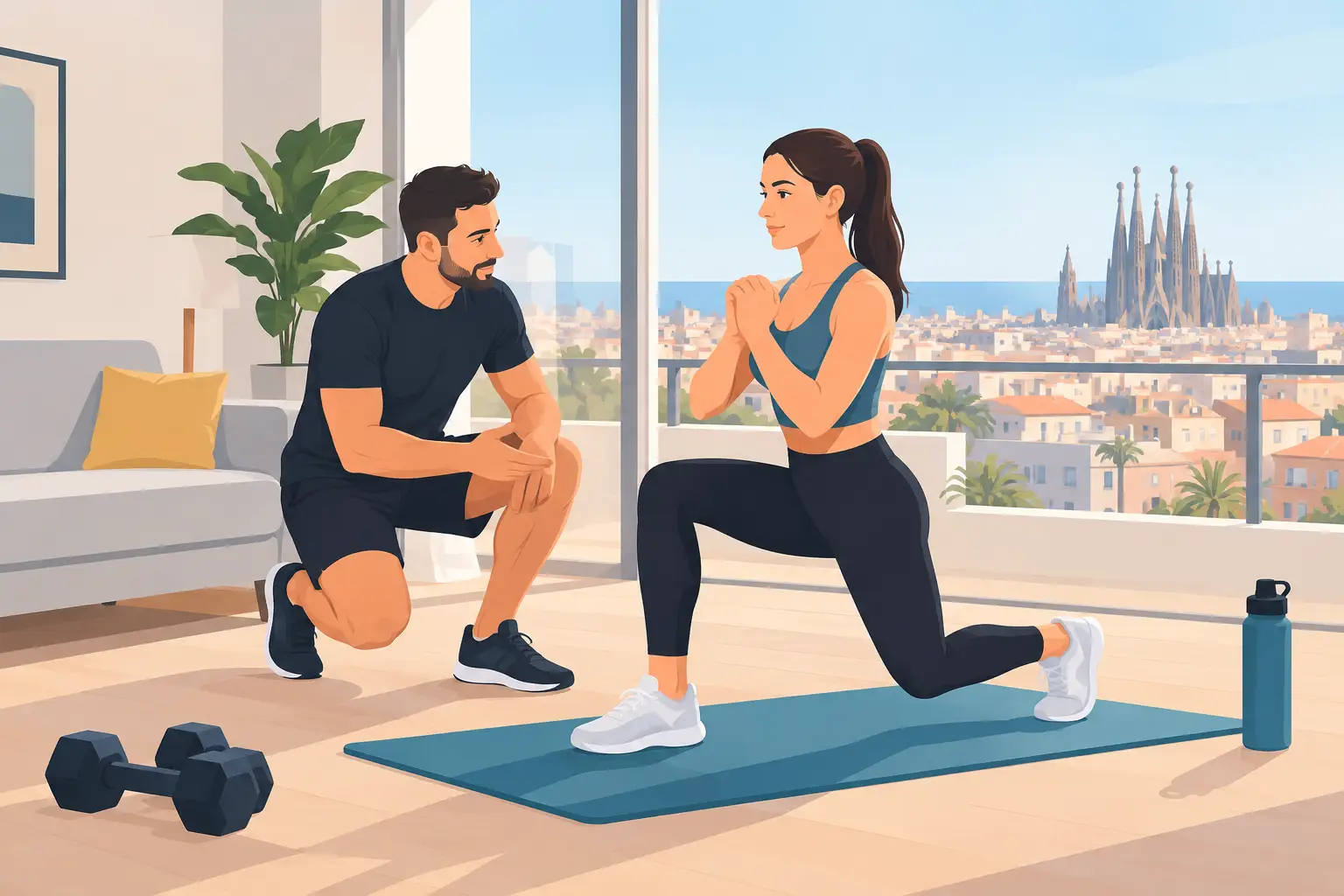
A packed diary, a crowded gym and a plan you do not enjoy are a reliable recipe for missed sessions. If you are wondering, can personal trainers visit homes, the answer is yes – and for many people in Barcelona, it is the most realistic way to train consistently.
I bring structured, one-to-one coaching to your home, building, terrace or nearby outdoor space. You do not need to be an experienced gym-goer, own a room full of equipment or spend an hour travelling across the city. You need a clear plan, the right level of challenge and somebody who expects you to show up.
Can personal trainers visit homes safely and effectively?
A good personal training session is not defined by a gym postcode. It is defined by coaching quality: understanding your starting point, choosing the right exercises, watching your technique and progressing the work at the right pace. All of that can happen at home.
Before we start, I look at your goals, training history, injuries or limitations, available space and schedule. A client wanting to lose body fat, someone rebuilding strength after a long break, and a runner preparing for a race should not receive the same session simply because they are in the same living room.
Home training also works because it removes friction. There is no commute, no waiting for machines and no uncertainty about what to do when you arrive. At the planned time, I am at your door and we get to work. For busy professionals, parents and people who find a conventional gym intimidating, that consistency is often the difference between good intentions and measurable progress.
Safety still matters. I will adapt exercises to the layout and surface available, keep the session appropriate to your current ability and coach movement closely. If your flat has limited room, that does not mean limited training. Bodyweight conditioning, resistance bands, dumbbells, kettlebells, TRX and simple cardio drills can create demanding, well-rounded sessions without turning your home into a commercial gym.
What a home personal training session looks like
The session begins with a purposeful warm-up, not a few rushed stretches. We prepare the joints and muscles you will use, raise your heart rate and assess how your body feels that day. This is particularly useful if you sit at a desk, have travelled recently or are returning after illness or injury.
The main work is built around your programme. It may focus on strength, body composition, mobility, conditioning, running support or a combination of these. You might learn how to squat and hinge with confidence, build upper-body strength, improve core control or complete a challenging circuit designed around your fitness level.
I coach the details that are easy to miss when training alone: posture, range of movement, breathing, tempo and when to push harder. The goal is not to leave you exhausted for the sake of it. It is to create sessions that move you forwards week by week.
We finish with a short cool-down where appropriate, then discuss what comes next. That could mean a simple movement target, nutritional focus, recovery advice or the next workout in your plan. Training at home should not feel like an isolated hour. It should support the way you live between sessions as well.
You do not need much equipment
One of the biggest misconceptions about home coaching is that you need a large spare room and expensive kit. In reality, a clear area around the size of a yoga mat can be enough to start. I can bring portable equipment where needed and make sensible recommendations if buying a few pieces would help your long-term training.
More equipment can give us more variety, especially for strength development, but it is not a shortcut. Progress comes from good exercise selection, sound technique, appropriate resistance and consistent effort. A pair of dumbbells used well will achieve more than an untouched home gym.
Home, outdoors or online: which option suits you?
Home sessions are ideal when convenience and privacy are your priorities. They suit people with demanding work schedules, those who prefer not to train in busy gyms, beginners who want individual attention and clients who want a coach to fit around family life.
Outdoor training can be a better fit if you enjoy fresh air, want more room to move or are working towards a running event. Barcelona offers excellent spaces for conditioning, endurance work and race preparation. I have completed Ironman triathlons, marathons and years of multi-sport training, so I understand that endurance goals need more than a hard session now and then. They need pacing, progression, recovery and a plan that fits the rest of your life.
Online coaching is useful if you travel often, live outside Barcelona or want structured support between in-person sessions. You still receive a bespoke programme and direct guidance, but complete your workouts where and when it works for you. Many clients use a blended approach: face-to-face coaching to build confidence and technique, alongside remote sessions for flexibility.
There is no universally best format. The right choice is the one you can follow consistently and that gives you the coaching support your goal requires.
Who benefits most from a trainer at home?
Home personal training is not only for people starting from zero. It works for complete beginners who want to learn safely, experienced exercisers who have stalled, couples wanting to train together and small groups of friends looking for a more focused alternative to a class. I can train groups of up to four people, adapting the same session so that everyone is challenged at the right level.
It also works well for international clients in Barcelona. If English is the language in which you feel most comfortable discussing your goals and asking questions, that matters. Clear communication makes it easier to understand technique, nutrition and the reasons behind your programme. I also coach in French and Spanish.
For clients focused on fat loss or body composition, exercise is only part of the picture. A bespoke nutrition plan can provide structure around meals, protein, portion sizes and habits without forcing you into an unrealistic diet. You should be able to enjoy life in Barcelona and still make progress. The answer is usually better planning and accountability, not extreme restriction.
How to prepare for your first session
You do not need to get fit before meeting a trainer. Be honest about where you are now, what you have tried before and what has made consistency difficult. That information is far more useful than pretending everything is fine.
Wear comfortable clothes, have water available and make enough space to move safely. If possible, avoid scheduling your first session immediately after a very large meal or a long day with no food at all. Beyond that, arrive ready to learn and willing to work.
Your first session is also your opportunity to decide whether the coaching style suits you. You should expect support, clear instruction and encouragement, but also standards. I will meet you at your level, then help you move beyond the routines and excuses that have kept you stuck.
Making home training deliver lasting results
The convenience of a home visit is valuable, but it is not magic. Results still depend on regular training, recovery, food choices and a programme that changes as your fitness improves. A coach provides direction and accountability; you provide the commitment to follow through.
Start with a schedule you can protect. Two well-executed sessions each week are more effective than an ambitious five-session plan that disappears after ten days. From there, we can build strength, fitness and confidence without making training take over your life.
If your home is where your schedule is busiest, it can also become the place where you finally make time for yourself. Set aside the space, commit to the session and let the first workout be the practical start of a stronger routine.