
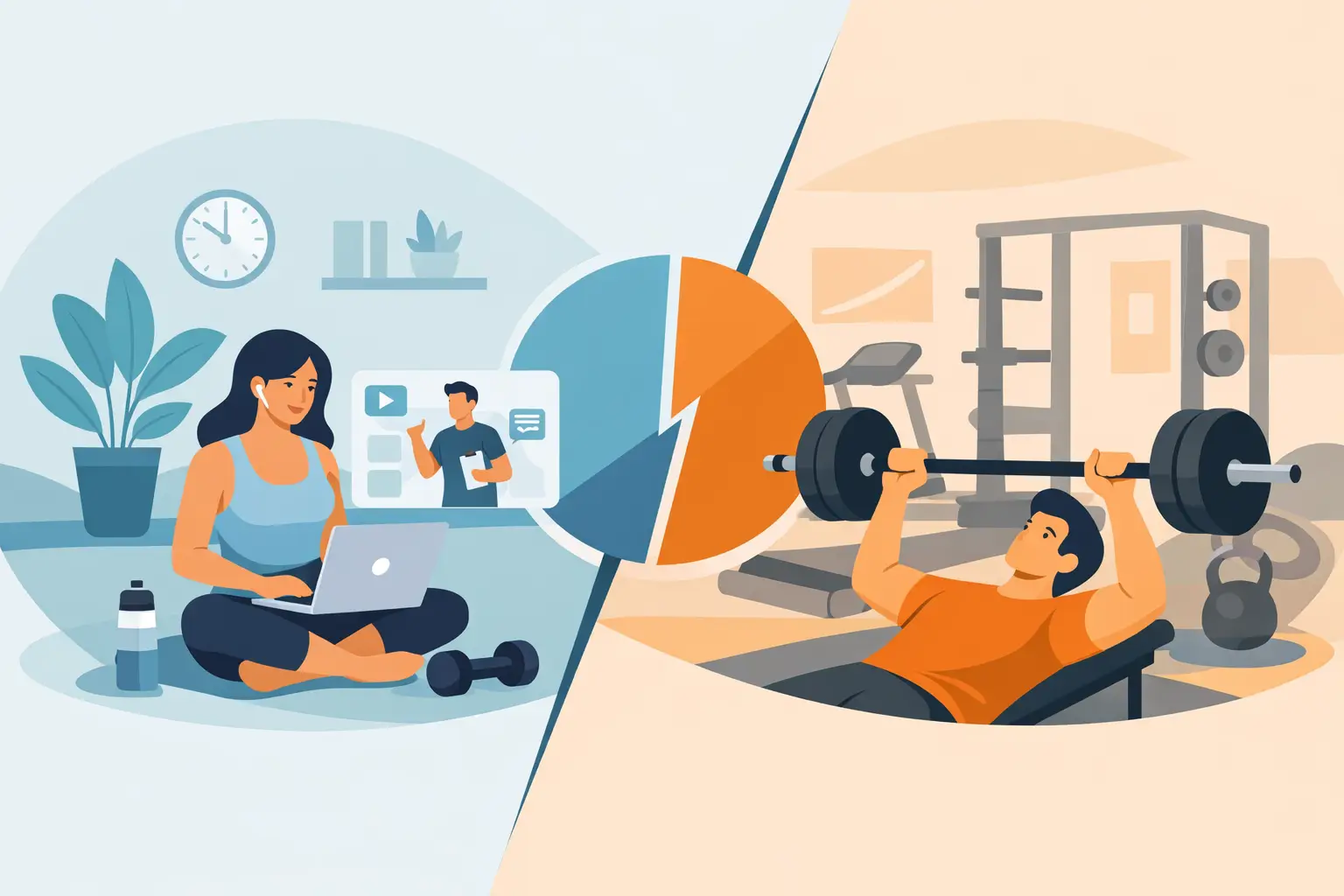
A gym can be five minutes from your flat and still be the hardest place to train consistently. The issue is rarely access alone. It is knowing what to do, making time when work gets busy, and having someone notice when motivation starts to slip. That is where the online coaching versus gym membership decision becomes more useful than simply asking which option costs less.
Both can improve your fitness. A gym membership gives you equipment, space and the freedom to train whenever it suits you. Online coaching gives you a plan built around your goal, your schedule and the equipment you actually have, alongside direct accountability. The better choice depends on what has stopped you getting results in the past.
What a gym membership really gives you
A conventional gym is a good option if you enjoy training independently and will genuinely use the facilities. For strength training, access to barbells, cable machines, dumbbells and cardio equipment can be valuable. It can also provide a change of scene after a day working from home, particularly if you like the energy of a busy training floor.
The challenge is that a membership is access, not direction. You still need to decide what to train, how much to do, when to progress, and whether your technique is good enough to load an exercise safely. Many people start with enthusiasm, then repeat the same comfortable sessions for months because they are unsure how to move forward.
This is not a problem for everyone. An experienced lifter with a clear programme and solid self-discipline may get excellent value from a gym. If you have trained for years, enjoy researching programming and can keep appointments with yourself, the freedom can work in your favour.
For beginners, or anyone returning after time away, too much choice can become a barrier. Walking into a room full of equipment without a clear plan is often enough to turn a good intention into a short treadmill walk and an early exit.
Online coaching versus gym membership: the real difference
The main difference is not whether you train through a screen or in a gym. It is whether your training has a clear owner.
With online coaching, I build the programme around the outcome you want: fat loss, stronger movement, muscle gain, better running performance, more energy, or confidence in your body. Your training is then adjusted to your starting point, injury history, travel plans, available time and equipment. If you have a home setup with a pair of dumbbells, that is enough to start. If you train in a gym, the programme can use the equipment there without becoming generic.
A good online coach also looks beyond the workout. Nutrition habits, daily movement, recovery, stress and sleep all affect results. There is little value in prescribing an ambitious six-day routine to someone who is travelling for work, sleeping poorly and can realistically manage three sessions. The right plan should challenge you, but it must fit your real life well enough to be repeated.
That flexibility is particularly useful for busy professionals in Barcelona and international clients who move between cities. You do not lose your training structure because you are on holiday, working late, or away from your usual gym. We adapt the session, keep the standard high and continue moving forward.
Accountability is where results are usually decided
Most people do not need another list of exercises. They need a reason to complete them when the week becomes demanding.
A gym membership relies heavily on self-accountability. You pay at the start of the month, but nobody checks whether you attended twice, twenty times or not at all. That can be ideal if independence motivates you. It is less helpful if you regularly postpone training until the next Monday.
Online coaching creates a regular point of contact. You have a programme to follow, sessions to report back on and someone looking at how you are progressing. If an exercise feels wrong, a workout becomes too easy, or you miss a week, the response is not guilt. It is an adjustment and a plan to get going again.
That relationship matters because progress is rarely perfectly linear. Your weight may stall while your strength improves. A stressful week may affect your energy. You might need to reduce running volume before a race, or change training around a sore knee. A coach can see the wider pattern rather than judging one difficult week in isolation.
Cost matters, but value matters more
On the surface, a gym membership is usually cheaper than one-to-one online coaching. If you use the gym often, know what you are doing and enjoy working alone, it can be a sensible investment.
However, the monthly price is only part of the calculation. An inexpensive membership that goes unused is not good value. Equally, a generic workout app can look convenient but may not account for your fitness level, your technique, your nutrition or what happened in your last session.
Online coaching costs more because it includes individual planning, programme changes, feedback and direct support. For many clients, that structure reduces the costly cycle of starting, stopping and beginning again. You are paying for expertise, but also for a process that makes consistent action more likely.
If budget is tight, a blended approach often works well. Use a local gym for equipment and follow an online programme that tells you exactly how to use it. You keep the lower facility cost while gaining personal direction and accountability.
Convenience is not the same as ease
A gym with 24-hour access sounds convenient, but the journey still has to happen. Changing clothes, travelling there, waiting for equipment and travelling back can turn a 45-minute workout into a two-hour commitment. On a full working day, that is often the point where training gets dropped.
Online coaching can remove much of that friction. A focused home session, an outdoor workout near the beach or a hotel routine while travelling can all be effective when they are properly designed. You do not need a perfect setup to improve your strength and fitness. You need progressive training performed consistently.
There is a trade-off. Some people thrive on the atmosphere of a gym and find home training too easy to avoid. Others dislike crowded spaces or feel self-conscious when starting out. Be honest about your environment. The best programme is not the most impressive one on paper. It is the one you will complete week after week.
Who should choose each option?
A gym membership may suit you if you enjoy the gym environment, have specific equipment needs, understand how to programme your own training and can remain consistent without outside support. It can be especially useful for advanced strength work, provided you have a plan and train with good form.
Online coaching may suit you better if you want clear structure without being tied to one location. It is a strong choice if you are new to training, short on time, struggling with motivation, preparing for a running event, or frustrated by programmes that do not adapt when life changes. It also works well for people who want nutrition guidance alongside training rather than treating exercise as a separate task.
For couples or friends, small-group sessions can offer another route: shared motivation, professional coaching and a more personal feel than a busy class. The important thing is that the training still reflects each person’s ability and goal, rather than forcing everyone through the same workout.
Choose the support that changes your behaviour
Do not choose based only on the equipment you think you should use. Choose based on the support that helps you show up. If a gym gives you energy, structure and consistency, use it properly. If you need a tailored plan, direct feedback and someone in your corner wherever you are, online coaching can be the stronger investment.
The aim is not to find the toughest-looking routine. It is to build a routine you can sustain, progress and feel proud of. Start with the option that makes your next session more likely to happen, then let consistent work do the rest.