
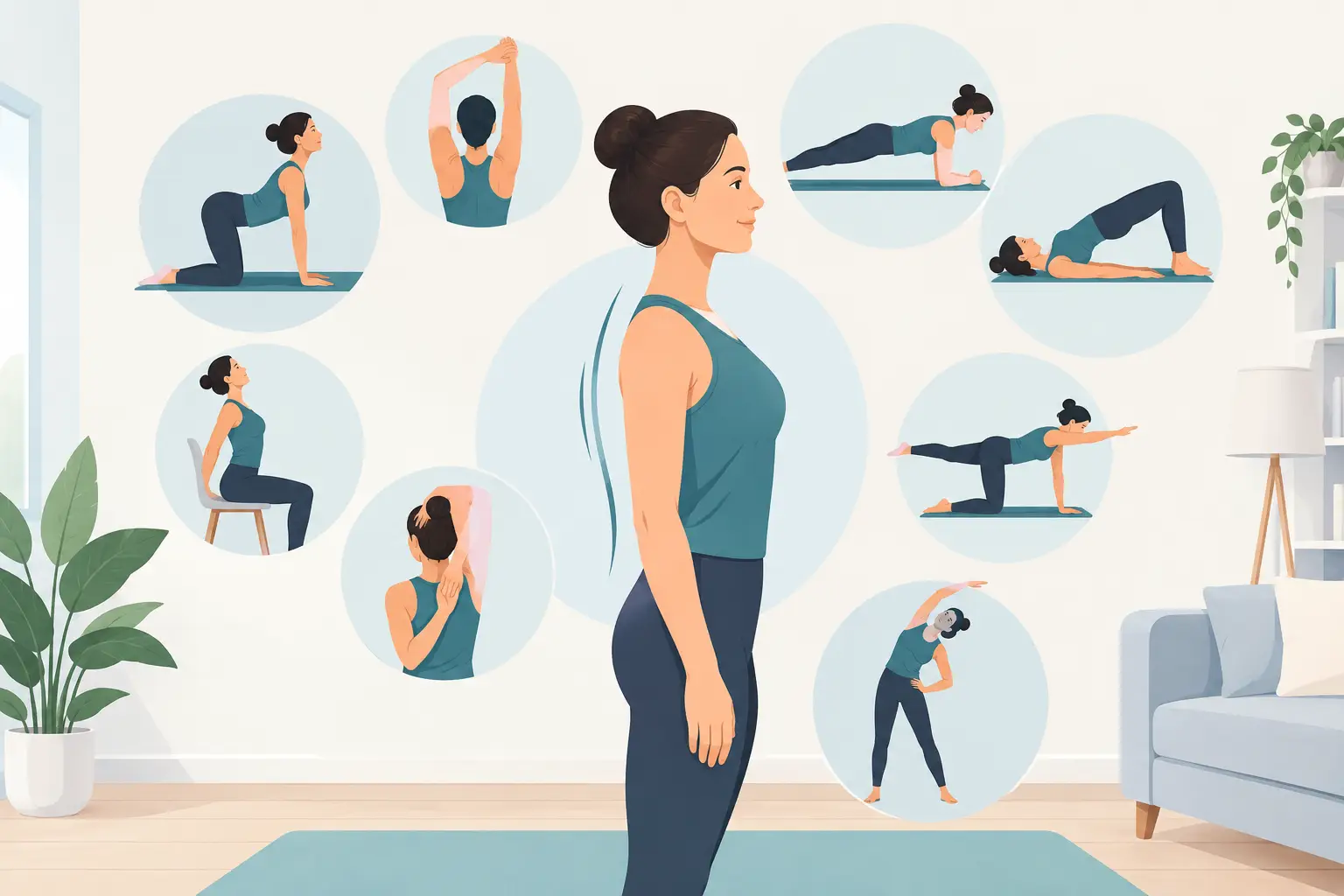
A rounded upper back, stiff neck and shoulders that creep towards your ears rarely come from one bad sitting position. They usually reflect long hours at a laptop, too little movement, weak control in key muscles and training that does not balance your day. The best exercises to improve posture do not force you into a rigid military stance. They build the strength and mobility to hold yourself well while working, walking, running and training.
For busy professionals in Barcelona, the answer is not necessarily another hour in the gym. A focused 10 to 15 minutes, performed consistently at home or outdoors, can make a real difference. The goal is simple: strengthen the muscles that support your spine and shoulder blades, restore movement where you have become stiff, and practise better positions without overthinking them.
What good posture really looks like
Good posture is not about pinning your shoulders back all day or forcing your lower back flat. Your body needs to move. A healthy posture is one you can change easily, with your head, ribcage, pelvis and feet working together without constant tension.
If you spend most of your day seated, you may notice a forward head position, rounded shoulders, a tight chest and hips that feel locked up. If you run or cycle regularly, you may have excellent fitness but still lack upper-back strength or hip control. These patterns are common, and they are trainable.
The exercises below work because they address the areas most often neglected: deep neck control, upper-back mobility, shoulder-blade strength, core stability and glute strength. If an exercise causes sharp pain, pins and needles, dizziness or symptoms travelling into an arm or leg, stop and seek advice from a qualified health professional.
The best exercises to improve posture
You do not need to do every exercise daily. Start with five or six movements, two or three times per week, and keep the quality high. A resistance band, a light dumbbell or two, and a wall are useful, but several of these can be done with no equipment.
1. Chin tucks
Chin tucks train the deep muscles at the front of the neck and help counter the habit of leading with your chin towards a screen. Stand against a wall or sit tall. Look straight ahead, then gently draw your chin backwards as though making a double chin. Keep your eyes level and avoid tipping your head down.
Hold for three to five seconds, relax, and repeat for eight to 12 repetitions. This should feel controlled rather than aggressive. If your neck is already very tense, use a smaller movement.
2. Wall slides
Wall slides teach your shoulder blades to move well while keeping your ribs under control. Stand with your back to a wall, feet slightly forward and knees soft. Place your arms against the wall in a goalpost shape, then slowly slide them upwards as far as you can without your lower back arching or your shoulders shrugging.
You may not reach overhead immediately, and that is fine. Work within the range you own. Perform two sets of six to 10 slow repetitions, breathing out as your arms rise.
3. Thoracic extensions over a chair
The thoracic spine is the middle and upper part of your back. It is designed to extend and rotate, but desk work often leaves it stuck in a rounded position. Sit on a firm chair with the backrest below your shoulder blades. Support your head lightly with your hands and lean your upper back over the chair, keeping your lower ribs from flaring excessively.
Take four or five calm breaths in this position, then return upright. Repeat two or three times. This is mobility work, not a competition to bend as far as possible.
4. Band pull-aparts
Band pull-aparts are simple, portable and highly effective for building endurance in the upper back. Hold a light resistance band at shoulder height with straight but relaxed arms. Pull the band apart by moving your hands outwards and gently drawing your shoulder blades back and down.
Do not crank your chest forwards or turn it into a neck exercise. Aim for two or three sets of 12 to 20 repetitions. A lighter band with clean form is better than a heavy band that makes you shrug.
5. Resistance-band rows
Rows strengthen the lats, rhomboids and mid-back muscles that help control your shoulder blades. Anchor a band securely at around chest height, stand tall and pull your elbows back towards your sides. Pause briefly when your hands reach your ribs, then return slowly.
Keep your neck long and your ribs stacked over your pelvis. Two to four sets of eight to 15 repetitions work well. As you become stronger, increase tension gradually rather than rushing the movement.
6. Prone Y-T-W raises
Lie face down on the floor or a bench with your forehead supported by a folded towel. Lift your arms into a Y shape, then a T shape, then bend your elbows to form a W. In each position, think about reaching long from the shoulders rather than jamming the shoulder blades together.
These small raises can be surprisingly demanding. Start with one or two rounds of five to eight repetitions in each position. For many people, bodyweight is enough. Adding weights too early often shifts the work into the neck.
7. Dead bugs
A stronger core does not mean endless crunches. For posture, you want to control the position of your ribcage and pelvis as your limbs move. Lie on your back with arms pointing upwards and hips and knees bent to 90 degrees. Gently brace your stomach, then lower the opposite arm and leg towards the floor without your back lifting or arching.
Return to the start and alternate sides. Complete six to 10 controlled repetitions per side. If maintaining contact with the floor is difficult, shorten the range of motion.
8. Glute bridges
Your glutes help stabilise the pelvis when you stand, walk, climb stairs and run. When they are underused, the lower back often tries to do more than its share. Lie on your back with knees bent and feet hip-width apart. Push through your feet and lift your hips until your body forms a straight line from shoulders to knees.
Pause for two seconds while squeezing your glutes, then lower with control. Avoid over-arching at the top. Try two or three sets of 10 to 15 repetitions. Once this feels easy, progress to a single-leg bridge or add a band around the knees.
9. Split squats
Posture is built from the ground up. Split squats train your legs, glutes and balance while challenging you to keep your torso steady. Take a staggered stance, lower your back knee towards the floor and rise by pressing through the front foot. Keep your front knee tracking in line with your toes and your chest comfortably tall.
Begin with bodyweight and perform two or three sets of six to 10 repetitions on each side. Holding a weight can be useful, but only once you can control your balance and pelvis position.
10. Side planks
Side planks develop lateral core strength, which helps you resist collapsing through one hip when standing or walking. Lie on your side with your elbow under your shoulder and knees bent. Lift your hips so that your body forms a straight line from shoulders to knees. Progress to straight legs when ready.
Hold for 15 to 30 seconds per side, for two or three rounds. Keep breathing. A side plank performed with a clenched jaw and held breath is not the stable position we are looking for.
Turn the exercises into a routine you will actually do
Consistency beats the perfect programme abandoned after a week. On two or three non-consecutive days, choose chin tucks, wall slides, rows, dead bugs, glute bridges and split squats. That gives you a balanced session in around 15 minutes. Add thoracic extensions during a work break, especially after a long video call or concentrated laptop session.
Your daily environment matters as much as the session itself. Raise your screen so you are not constantly looking down, change position regularly, take calls while walking where possible, and avoid treating one ‘perfect’ sitting posture as a position you must hold for eight hours. Movement breaks are usually more valuable than sitting rigidly.
Progress should be measured by more than appearance. You may notice that your shoulders feel less tight after work, your running form feels more relaxed, or you can row and press with better control. Those are meaningful improvements. If you have persistent back or neck pain, a history of injury, or a condition affecting your spine, your programme should be adapted rather than copied from a generic routine.
At AB Fitness, I build posture work into personalised home, outdoor and online sessions because your training needs to fit your work, equipment, sport and starting point. The right exercise is the one you can perform well, progress safely and repeat often enough for your body to learn from it.
Start with one session this week. Move slowly, breathe properly and finish feeling more organised than when you began. That is a far better foundation for posture than trying to hold yourself perfectly still.