
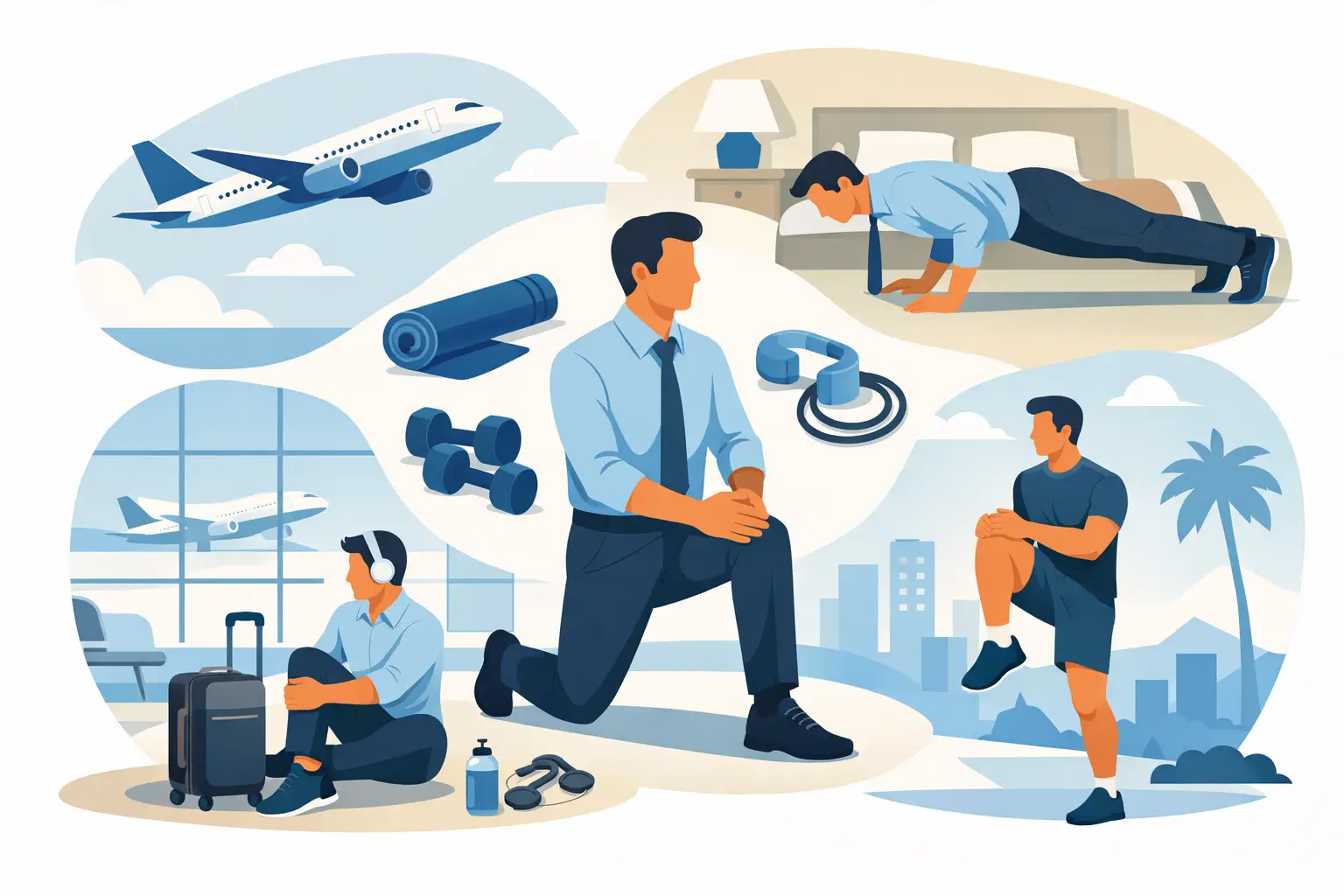
A 45-minute gap in your calendar is not a fitness plan. If that gap appears once a week between meetings, school runs, flights and social plans, you need training that works in the time you genuinely have. The best exercises for busy professionals are not complicated, exhausting for the sake of it, or dependent on a fully equipped gym. They train the movements your body needs, deliver a clear return on your effort and can be adapted to your home, a park or a hotel room.
I work with busy clients across Barcelona and remotely, and the same issue comes up repeatedly: people do not fail because they are lazy. They fail because their plan expects a schedule they do not have. A good programme meets you where you are, then builds consistency and progression from there.
What makes the best exercises for busy professionals?
When time is limited, favour exercises that use several muscle groups at once. A squat trains your legs and trunk. A press develops your chest, shoulders and arms while asking your core to stabilise. A carry builds grip, posture and whole-body strength. These movements give you more value than spending 20 minutes isolating one small muscle group.
The right choice still depends on your starting point. If you have knee pain, high-impact jumping may not be the answer. If you sit at a desk all day, your upper back and hips may need more attention. If you are preparing for a race, your conditioning work will look different from someone focused on strength and body composition. The principle is simple: use the biggest safe movements you can perform with good control, then progress them gradually.
You do not need to train hard every day. Two or three focused strength sessions each week, supported by walking, running, cycling or short conditioning sessions, is enough to make meaningful progress. The important part is that your plan remains realistic during busy weeks, not just when life is unusually calm.
1. Squats for lower-body strength
A squat pattern should be a foundation of almost every busy professional’s training. Strong legs make everyday life easier, from climbing the stairs to carrying shopping, and they support better running, cycling and sporting performance.
Start with a bodyweight squat to a chair or bench if you are new to training. Keep your feet around shoulder width, let your knees track in line with your toes and sit down under control before standing tall. Once this feels comfortable, progress to goblet squats with a dumbbell or kettlebell held at your chest.
For a quick strength block, perform three sets of eight to 12 controlled repetitions, resting for around 60 seconds. The quality of each repetition matters more than rushing through a high number. If you travel regularly, a slow tempo bodyweight squat is challenging without any equipment: lower for three seconds, pause briefly, then stand with purpose.
2. Push-ups and presses for upper-body strength
Push-ups are one of the most useful exercises available because they can be done nearly anywhere and adjusted for any level. They train the chest, shoulders, triceps and core, provided you keep a straight line from shoulders to heels rather than letting your hips drop.
Beginners can begin with hands on a kitchen worktop, bench or sturdy table. This elevated position reduces the load while allowing you to learn the movement properly. As you become stronger, use a lower surface, then move to floor push-ups. A dumbbell floor press is another excellent option when you have a pair of weights at home.
Avoid chasing failure on every set. Leave one or two good repetitions in reserve most of the time. That approach lets you recover, maintain better form and train consistently rather than needing several days to feel normal again.
3. Hip hinges for strength and posture
Long periods at a desk can leave your hips feeling tight and your glutes underused. A hip hinge teaches you to load the hips while keeping your back stable. It is a key movement for building stronger glutes and hamstrings, which matters for posture, running power and general resilience.
The simplest place to start is a glute bridge. Lie on your back with knees bent, press through your feet and lift your hips without overextending your lower back. Once you can control this well, use single-leg bridges or add load across the hips.
For clients with access to dumbbells or kettlebells, Romanian deadlifts are highly effective. Keep the weight close to your legs, soften your knees and send your hips backwards as though closing a car door behind you. You should feel tension in the hamstrings, not strain in the lower back. This is a movement worth learning carefully, especially if you have a history of back discomfort.
4. Rows to counterbalance desk work
Most busy professionals spend more time rounded over a laptop than they realise. Rows strengthen the muscles around the upper back and help balance pressing exercises. They are not a magic cure for poor posture, but they are a practical part of a stronger, more capable body.
A resistance band row is ideal for home or hotel training. Anchor the band securely, pull your elbows towards your ribs and pause as you squeeze your shoulder blades together. If you have dumbbells, a supported one-arm row is equally useful. Keep your torso stable and avoid twisting to lift a weight that is too heavy.
Aim for slightly more pulling than pushing in your weekly strength work, particularly if you spend long hours seated. Two or three sets of 10 to 15 rows after your push-ups will give your upper body a more balanced session.
5. Carries for core strength that transfers to life
Carries look simple: pick up a weight and walk. Done properly, they challenge your grip, core, shoulders and posture in a way that transfers directly to everyday tasks. They also teach you to stay tall and controlled under load.
A farmer’s carry uses a weight in each hand. Walk slowly for 30 to 45 seconds, keeping your ribs down, shoulders away from your ears and steps steady. If you only have one weight, carry it on one side and resist leaning towards it. This suitcase carry is particularly demanding for the side of your core.
If weights are unavailable, do not force the exercise with an awkward suitcase or unstable object. Use planks or dead bugs instead. The best option is the one you can do safely and repeat consistently.
6. Short conditioning that does not take over your week
Cardio does not need to mean a long, punishing session. Brisk walking, running intervals, cycling hills or a short bodyweight circuit can improve fitness without taking over your diary. The right intensity depends on your experience, sleep, stress and current training load.
For a simple 15-minute outdoor session, warm up with five minutes of easy walking or jogging. Then alternate one minute at a comfortably hard pace with one minute easy for five rounds. Finish with a few relaxed minutes to bring your breathing down. You should work hard enough to feel challenged, but not so hard that you dread repeating it later in the week.
At home, try a controlled circuit of squats, incline push-ups, rows with a band and glute bridges. Work for 40 seconds, rest for 20 seconds and repeat for three or four rounds. Keep the pace honest, but do not sacrifice form merely to chase sweat.
Build a week you can actually keep
A busy week does not require a perfect routine. It requires a minimum standard. For many people, that could be two 30-minute full-body strength sessions and one 15 to 20-minute conditioning session. On the remaining days, walk more where possible. A mobile phone call taken on foot, a walk after lunch or an earlier stop on public transport all add useful movement without creating another appointment.
Here is how a 30-minute strength session can look: begin with squats and push-ups, then move to hip hinges and rows, and finish with carries or core work. Perform two or three sets of each, using a load and repetition range that feels challenging while staying controlled. If time is very tight, complete one quality set of each movement rather than skipping the session entirely.
Progress does not always mean adding more weight. You can add repetitions, improve range of motion, slow the lowering phase, reduce rest slightly or simply make the session more regular. Track what you do, even if it is only in your mobile phone notes. That gives you a clear starting point for the following week instead of guessing.
The goal is not to punish yourself for having a demanding career. It is to create a body that has the strength, energy and confidence to support it. Start with the session you can complete this week, do it properly, and let that small promise to yourself become a routine.